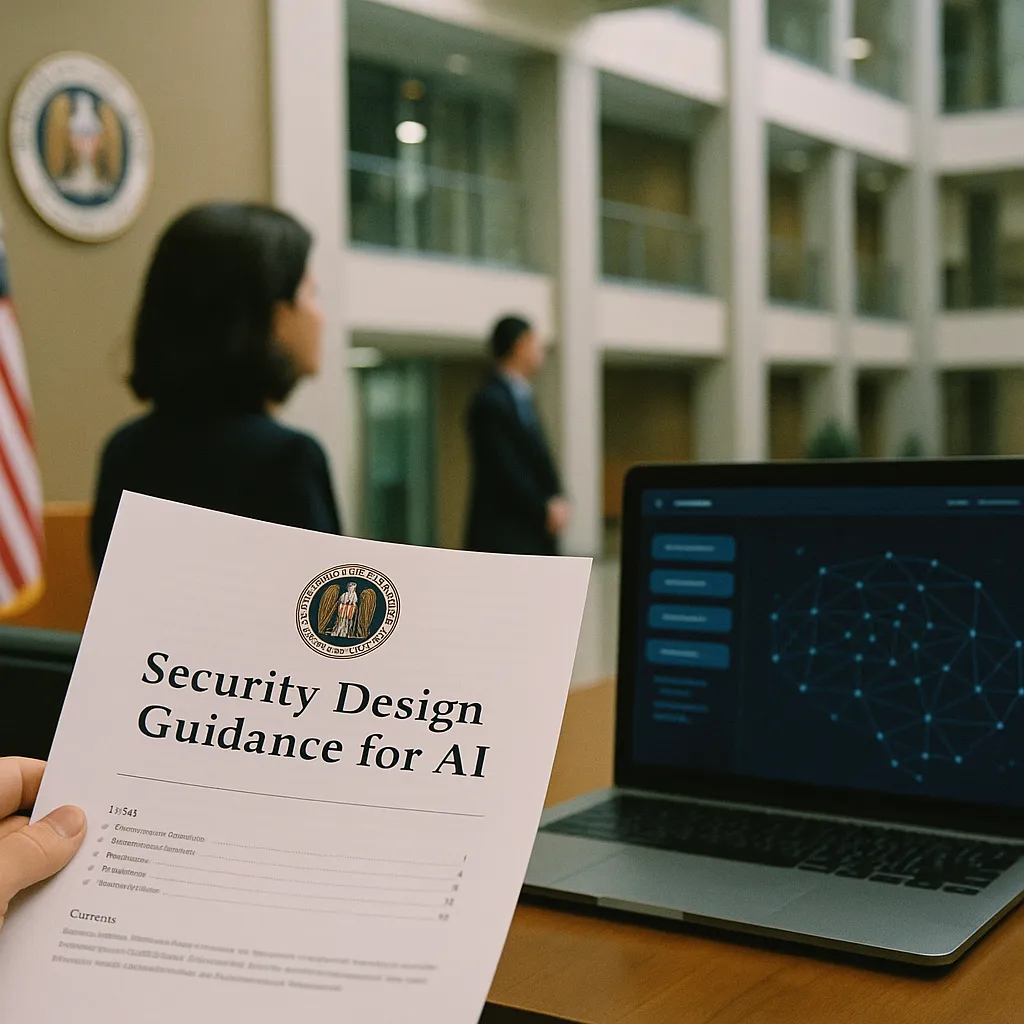
The NSA published dedicated security guidance for AI systems using the Model Context Protocol — the first federal acknowledgment that MCP has reached enterprise adoption scale.
NSA Issues Security Design Guidance for AI Automation Using the Model Context Protocol
By Hector Herrera | May 25, 2026 | Government
The National Security Agency has released formal security design guidance targeting AI systems that use the Model Context Protocol (MCP) — the emerging standard that allows AI agents to connect to external tools, databases, code environments, and services. The guidance identifies attack surfaces unique to MCP-connected systems and recommends architectural safeguards for enterprise deployments. The NSA publishing a dedicated MCP security document is the clearest signal yet that the protocol has reached mainstream adoption scale.
For organizations deploying AI agents in enterprise environments, this is no longer background reading. NSA guidance historically precedes regulatory requirements by 12 to 24 months.
What Is the Model Context Protocol
MCP, introduced by Anthropic in late 2024, is a protocol that standardizes how AI models communicate with external systems. Before MCP, connecting an AI agent to a database, a code execution environment, or an API required custom integration work for each connection. MCP creates a common interface — essentially a universal adapter — so that one AI agent can dynamically connect to many tools using the same protocol.
The practical result: AI agents can now browse files, query databases, execute code, call APIs, send communications, and interact with internal systems — all through a single standardized interface. Tools and platforms including Claude, Cursor, VS Code extensions, and dozens of enterprise software vendors have implemented MCP support, making it the closest thing the industry has to a standard for agentic AI connectivity.
That standardization is powerful. It is also a new attack surface.
What the NSA Found
The NSA's guidance identifies several attack vectors specific to MCP-connected AI systems:
Prompt injection through external data. When an AI agent retrieves data from an external tool — a document, a database record, a web page — that data can contain instructions that the model interprets as legitimate commands. An attacker who controls a document the agent will read can embed hidden instructions that redirect the agent's behavior. MCP expands the attack surface for this class of exploit because it increases the number and variety of external sources an agent interacts with.
Get this in your inbox.
Daily AI intelligence. Free. No spam.
Tool poisoning. If a malicious or compromised MCP server presents itself as a legitimate tool, an AI agent configured to use that tool will route actions through the attacker's infrastructure. This is analogous to a supply chain attack, but for AI agent tooling.
Privilege escalation via tool chaining. MCP enables agents to use multiple tools in sequence. An agent with limited permissions on any individual tool may be able to chain tool calls to achieve actions that exceed its intended authorization — accessing systems or data that no single tool call would allow.
Insufficient action authorization. MCP-connected agents can take consequential actions: sending emails, modifying files, executing database queries, booking calendar events. Many deployments do not implement sufficiently granular authorization controls — agents execute with the full permissions of the user or service account they run under, rather than the minimal permissions required for each specific task.
NSA's Recommended Safeguards
The guidance recommends several architectural controls for organizations deploying MCP-connected AI systems:
- Validate MCP server identity before allowing agent connections — treat MCP servers as untrusted unless cryptographically authenticated and authorized
- Implement least-privilege tool access — each agent should have access only to the tools and permissions needed for its defined task, not the full permission set of the user it runs under
- Add human-in-the-loop confirmation for consequential actions — file modifications, external communications, database writes, and API calls that change state should require explicit authorization rather than autonomous execution
- Log all tool calls and agent actions in a format that enables security monitoring and forensic analysis — treat agent action logs as equivalent to privileged user activity logs
- Sanitize external data before agent processing — content retrieved from external sources via MCP should be treated as potentially adversarial input, not trusted data
Why This Guidance Matters Now
MCP is roughly 18 months old. The speed with which the NSA is publishing dedicated guidance reflects both the protocol's rapid adoption and the agency's awareness that enterprise AI deployments are outpacing security frameworks.
Three indicators are worth noting:
First, MCP adoption is broad enough to be a systemic risk. The NSA does not publish technology-specific security guidance for niche or experimental standards. Dozens of enterprise software platforms, developer tools, and AI infrastructure vendors have implemented MCP support. It is in enough enterprise environments to warrant national-level attention.
Second, this guidance will likely shape procurement requirements. Federal agencies and government contractors subject to NSA guidelines will need to demonstrate MCP security controls as a condition of deploying AI agents. That requirement will cascade: vendors selling to the federal government will need to document MCP security architecture, and those vendor documentation standards will eventually propagate to commercial procurement requirements.
Third, the threat is active, not theoretical. The NSA does not publish reactive guidance. Security researchers have demonstrated working MCP prompt injection attacks in public research, and the agency's language reflects awareness of exploitation attempts already occurring in enterprise environments.
What Organizations Should Do
For enterprises currently deploying or evaluating MCP-connected AI agents:
- Audit your MCP server inventory. Know every tool your AI agents can connect to, who maintains it, and what permissions it runs under.
- Review agent permission scopes. Most initial MCP deployments were configured for convenience, not least-privilege. Tighten them.
- Implement action logging now, before it is mandated. Retroactively adding audit logging to agent workflows is significantly harder than building it in from the start.
- Treat this guidance as a preview of compliance requirements. NIST, CISA, and sector-specific regulators (OCC for finance, HHS for healthcare) typically follow NSA technical guidance within 12 to 24 months.
What to Watch
Watch for CISA and NIST to reference or expand on this guidance in broader AI security frameworks. The NSA's publication establishes the technical baseline; the regulatory timeline for compliance requirements will be set by follow-on guidance from civilian agencies. Also watch for MCP implementations to begin including built-in security features — authentication, permission scoping, and action logging — in response to this guidance, as protocol vendors compete on security posture.
Hector Herrera is the founder of Hex AI Systems and the author of NexChron.
Did this help you understand AI better?
Your feedback helps us write more useful content.
Get tomorrow's AI briefing
Join readers who start their day with NexChron. Free, daily, no spam.