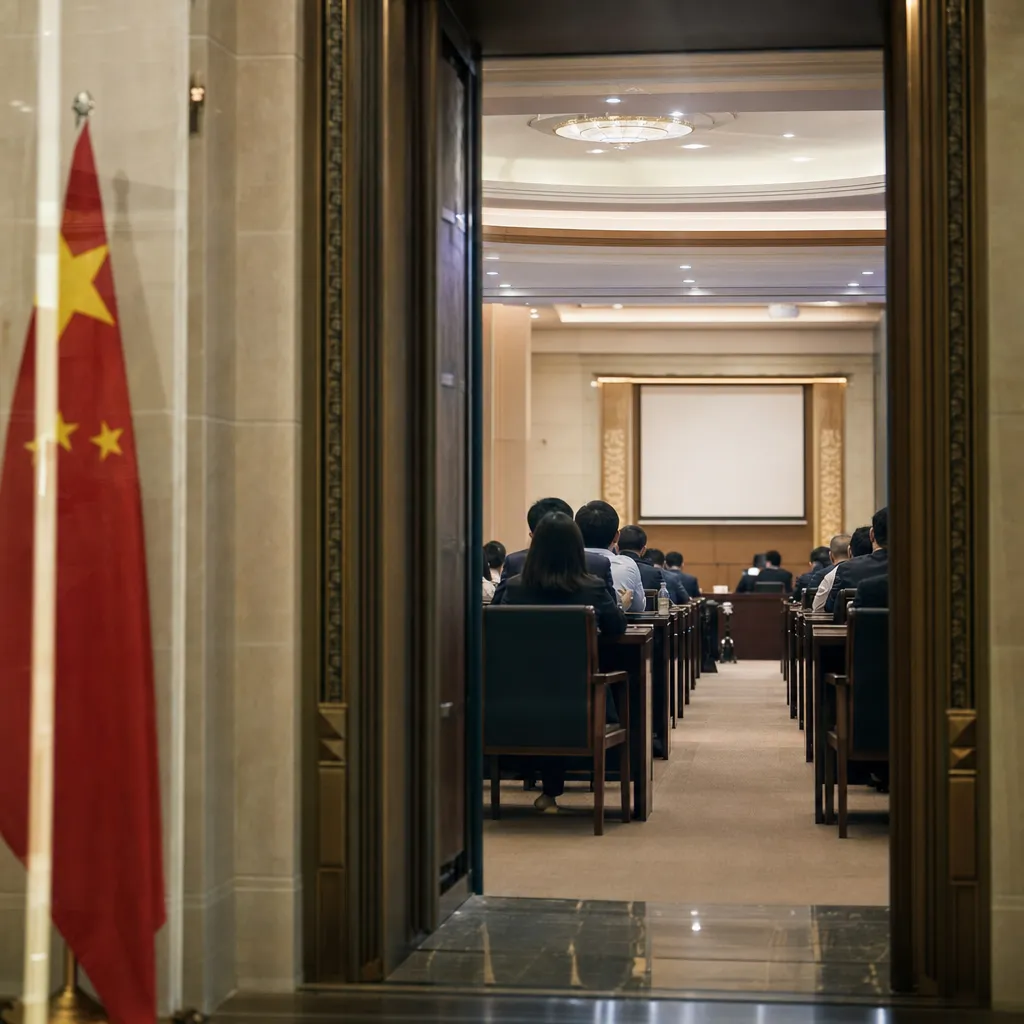
China's economic planner is accelerating legislation to govern AI from research lab to end user — covering frontier model safety, synthetic content, and AI anthropomorphism — positioning China alongside the EU as the second major comprehensive AI regulator.
China is drafting legislation to govern AI from the research lab to the end user, with the state economic planner accelerating a framework that covers frontier model safety standards, synthetic content disclosure, and restrictions on AI systems that present themselves as human. When finalized, China will become the second major jurisdiction — after the European Union — to have a comprehensive, end-to-end AI regulatory architecture rather than a patchwork of sector-specific rules.
The timing is not coincidental. A series of global security incidents involving uncontrolled AI systems has pushed China's regulators from incremental rulemaking toward a unified framework — one that positions Beijing as a governance leader alongside Brussels, not in opposition to it.
China's Layered Approach to AI Law
China has been building its AI governance stack piece by piece since 2021. The sequence:
- 2022: Algorithm recommendation rules — requiring platforms to disclose algorithmic curation to users
- 2023: Deep synthesis regulations — disclosure requirements for AI-generated video and audio (deepfakes)
- 2023: Generative AI measures — basic rules for large language model deployment, content labeling, security assessments
What Bloomberg reports is a move to unify and extend these frameworks under a single legislative umbrella. China's National Development and Reform Commission (NDRC) — the state economic planner — is driving the new legislation, which signals that this is being framed as an industrial policy priority, not just a consumer protection measure.
The Three Core Pillars
1. Frontier model safety standards. China would establish safety baselines that the most capable AI systems must meet before deployment. This directly targets the lab-to-market pathway for large models from Baidu, Alibaba, Tencent, and domestic frontier AI companies. The significance: until now, most Western observers characterized China's AI governance as PR-focused, light on technical requirements for high-capability systems. Safety standards for frontier models would change that characterization.
2. Synthetic content obligations. Mandatory disclosure requirements for AI-generated images, video, audio, and text — expanding on the 2023 deep synthesis rules. The practical scope is broad: news content, social media, advertising, entertainment. The enforcement mechanism matters more than the rule itself, and China's digital infrastructure gives it unusual capacity to enforce content labeling at scale.
Get this in your inbox.
Daily AI intelligence. Free. No spam.
3. AI anthropomorphism restrictions. Rules governing when AI systems must identify themselves as non-human — a direct response to growing use of AI in customer service, social companionship apps, and therapeutic contexts where users may not know they're interacting with a machine. This aligns with consumer protection provisions in the EU AI Act and pending US legislation on AI disclosure.
Why This Changes the Global Picture
China and the EU are now the only two jurisdictions building comprehensive AI regulatory frameworks. The United States has executive orders and voluntary commitments but no enacted comprehensive AI law. The UK is pursuing a sector-based, principles-driven approach. India, Japan, and most of the Global South are watching.
This means companies operating globally — including US-based AI developers — will increasingly face a de facto two-regulator world: EU AI Act compliance and Chinese AI law compliance. For companies that want to serve both markets, the frameworks will need to be reconcilable. Early analysis suggests there is significant overlap in the synthetic content and high-risk AI categories, but divergence in data governance, model transparency, and enforcement mechanisms.
China's framework also matters for geopolitical AI governance. Many countries in the Global South look to China as a technology governance model, not just a technology provider. If Beijing establishes detailed AI safety standards for frontier models, those standards may become the baseline for AI governance adoption in countries from Southeast Asia to Africa — without the Global South having participated in writing them.
What This Means for China's Own AI Industry
The domestic impact is not trivial. Chinese frontier AI companies — Moonshot AI (Kimi), Alibaba (Qwen), Zhipu AI (GLM), and others — will face compliance costs and pre-deployment safety assessment requirements that did not previously exist. The pattern in China's tech regulation has been that large incumbents absorb compliance costs more easily than startups, potentially consolidating the domestic AI market.
There is also a strategic dimension: Chinese AI companies seeking to operate in Europe already need to meet EU AI Act requirements. Aligning Chinese domestic safety standards with EU requirements — even partially — reduces the compliance divergence that makes global deployment complicated. The NDRC may be thinking about regulatory harmonization as much as domestic safety governance.
What to Watch
The legislation is in draft acceleration, not final form. The timeline for passage and enforcement is unclear. Watch for:
- Public comment periods that reveal which provisions face domestic industry pushback
- Bilateral discussions with EU counterparts on frontier model safety standard alignment — there are ongoing dialogues at the technical level
- Enforcement mechanisms for the synthetic content rules, which will determine whether this is substantive governance or paper compliance
The other jurisdiction to watch is the United States. If China and the EU both enact comprehensive AI laws while the US remains in a voluntary commitments framework, US AI companies will be writing compliance manuals for two foreign regulatory systems while operating under no binding domestic requirements at home — an increasingly untenable competitive position that may eventually accelerate US legislative action.
Source: Bloomberg, November 3, 2026
Did this help you understand AI better?
Your feedback helps us write more useful content.
Get tomorrow's AI briefing
Join readers who start their day with NexChron. Free, daily, no spam.