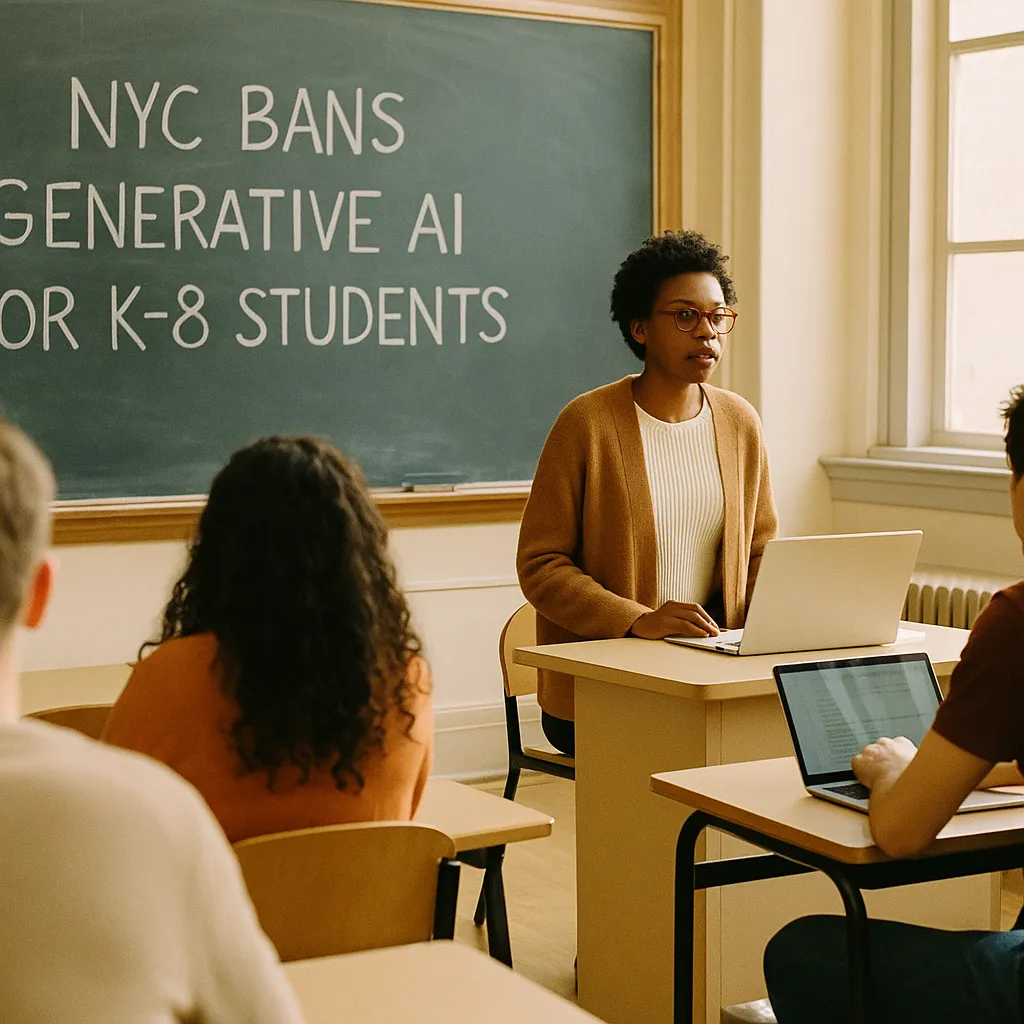
New York City placed a one-year moratorium on student-facing generative AI for all K–8 students, affecting nearly 600,000 children — the most expansive AI restriction ever imposed on a U.S. K–12 district.
NYC Bans Generative AI for K–8 Students in Nation's Largest School District
By Hector Herrera | September 19, 2026 | Education
New York City placed a one-year moratorium on student-facing generative AI tools for all K–8 students, affecting nearly 600,000 children in the nation's largest school system. The announcement — made September 17 by Mayor Zohran Mamdani and Schools Chancellor Kamar Samuels — is the most expansive AI restriction imposed on any U.S. K–12 district and signals that the city believes the risks of AI intermediation for younger learners outweigh the benefits until it has better evidence.
Alongside the moratorium, the city banned companion chatbots district-wide across all grade levels — an explicit response to products like Character.AI that have drawn scrutiny for their effects on adolescent emotional development. High schoolers remain exempt from the AI moratorium but will be required to complete mandatory AI critical thinking modules twice per academic year.
Why NYC Moved Now
The decision reflects a tension that has been building in classrooms since late 2022. AI writing tools, tutoring assistants, and research helpers proliferated into schools faster than any systematic evidence of their educational impact could accumulate. Districts and states have experimented with everything from full bans to full integration, with no clear consensus on what actually improves learning outcomes versus what simply makes assignments easier to complete.
New York City's moratorium leans toward caution. Rather than continuing to operate in a regulatory gray zone, the city is taking a one-year structured pause to build an evidence-based framework. It is not a permanent prohibition — and that distinction matters.
The exemption for high school students reflects an implicit theory of development: that AI literacy is an appropriate secondary-education concern, while cognitive development in younger children benefits more from unmediated learning. Whether that theory is correct is exactly what a year of research and evaluation might help answer.
What the Policy Covers
The moratorium applies to Pre-K through 8th grade students — roughly ages 5 to 14 — across the NYC Department of Education's approximately one million students.
Key provisions:
Get this in your inbox.
Daily AI intelligence. Free. No spam.
- K–8 students: full moratorium on student-facing generative AI tools on DOE networks and devices
- Companion chatbots: banned district-wide, including for high school students
- High schoolers (grades 9–12): exempt from the moratorium, but required to complete AI critical thinking modules twice per academic year
- Duration: one year, with an expected policy review and updated guidance at the end of the period
The policy does not appear to enumerate covered products by name, which means the DOE will need to publish a compliance framework — or default to blocking any AI tool not explicitly whitelisted.
The Vendor Impact
The NYC DOE is one of the largest edtech customers in the country. A K–8 moratorium on student-facing AI tools is a meaningful revenue event for companies that have built products targeting that segment.
Tools like Khanmigo (Khan Academy's AI tutor), Diffit, and a range of AI-assisted reading, math, and writing platforms will need to determine whether their products qualify as "student-facing generative AI" under the new policy — or whether they can argue they are teacher-facing tools that incidentally serve students. That distinction will be commercially significant.
The companion chatbot ban is broader and cleaner. No grade-level exemptions mean companies like Character.AI, Replika, and similar platforms have zero compliant path for NYC students.
What Other Districts Are Watching
New York City's education decisions carry disproportionate national weight. When NYC moves on curriculum, technology, or policy, Los Angeles Unified, Chicago Public Schools, and Houston ISD tend to follow within 12 to 18 months.
The federal Department of Education has published guidance on AI in schools but has not established binding national standards — leaving every district to make policy independently. That vacuum amplifies the NYC precedent. Expect similar moratorium proposals to surface in other large urban districts before the 2026–2027 school year ends.
Parent advocacy organizations that have pushed for stronger AI restrictions in classrooms will cite this decision as validation. EdTech vendors who built their revenue models around K–8 AI tools will push back hard through their trade associations.
What to Watch
The one-year timeline is the critical variable. If the NYC DOE uses the moratorium to develop rigorous evaluation criteria — with published evidence standards, student outcome data, and a vendor certification process — it could emerge as a national model that other districts adopt wholesale.
If the moratorium simply lapses without a follow-on policy, it will have been a delay rather than a solution.
Also watch for legal challenges on the companion chatbot ban. Several companies in that space have argued that age-based restrictions raise First Amendment concerns — a theory not yet tested against a school district's direct prohibition.
Sources: NYC Mayor's Office, September 17, 2026
Did this help you understand AI better?
Your feedback helps us write more useful content.
Get tomorrow's AI briefing
Join readers who start their day with NexChron. Free, daily, no spam.