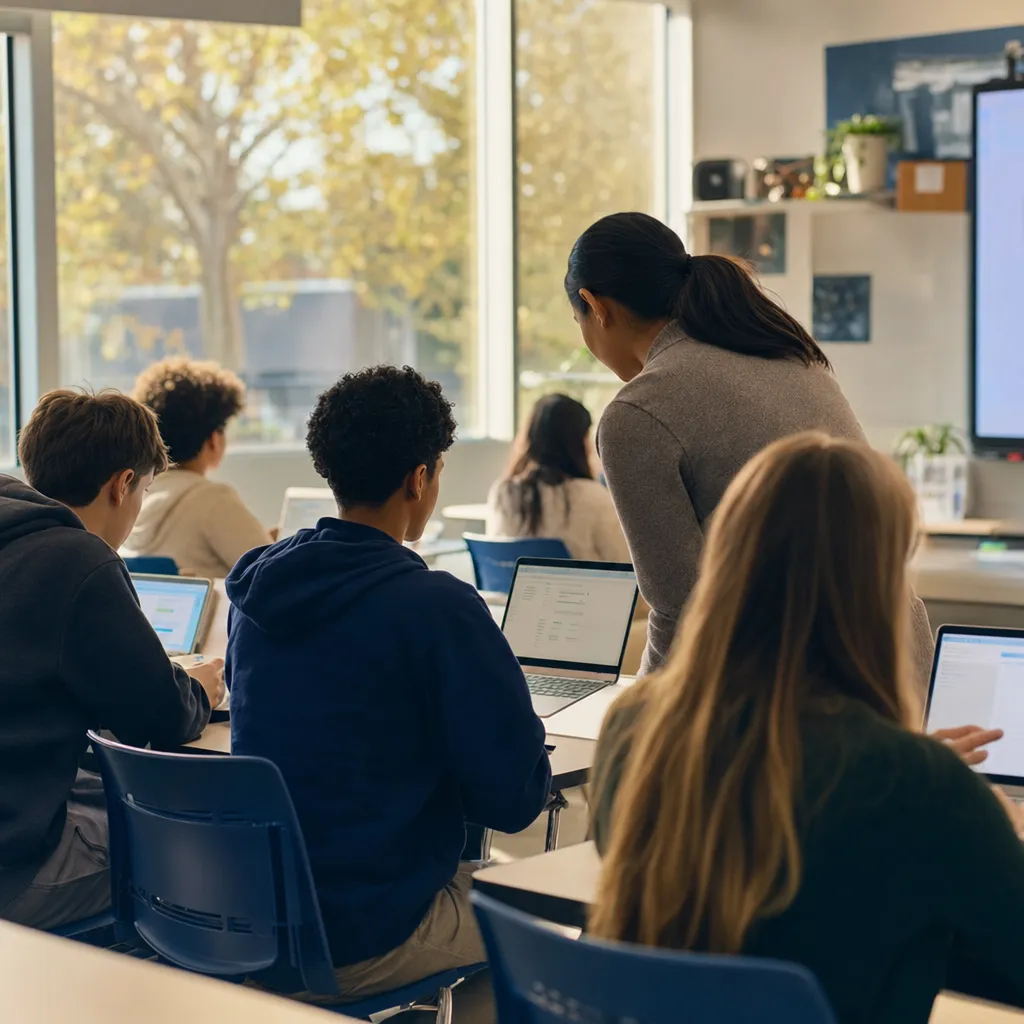
Google updated Classroom to give teachers visibility into students' Gemini AI sessions during assignments — putting AI-tutoring behavior under direct educator oversight for the first time.
Google has added teacher visibility into how students use Gemini Notebook inside Classroom assignments — a structural change that puts AI-tutoring behavior under direct educator oversight for the first time on the platform. The update arrives as schools across the country are still trying to figure out whether AI is a learning tool or an answer machine, and it lands with no consensus in sight.
What changed and why it matters now
Until this update, teachers assigning work through Google Classroom could see what students submitted but not how they got there. If a student spent forty minutes working through a problem with Gemini Notebook before writing their own answer, the teacher saw only the final answer. If they asked Gemini to just write it, the teacher saw the same thing. That asymmetry is what this feature begins to close.
Google's update doesn't give teachers a keystroke-by-keystroke replay — it surfaces the Gemini conversation history from within a Classroom assignment session, letting educators see what questions a student asked, what AI answered, and how the student's submitted work relates to what the AI produced. It is not a plagiarism detector. It is closer to watching someone do their homework over their shoulder.
The context: schools are flying blind
The visibility feature matters because most schools have AI policies that are aspirational rather than enforced. A 2026 Digital Education Council survey found 88 percent of students use AI tools for schoolwork, while fewer than a third of faculty feel they have meaningful ways to evaluate AI-assisted work. Google Classroom is the most widely deployed K-12 learning management system in the United States, with more than 170 million users globally, which means this single product change has more immediate classroom reach than any state AI education policy passed so far this year.
At the same time, universities are dealing with a messier side of AI detection: cases where students have been flagged, accused, and in some instances pursued legal action after AI detection tools produced false positives. The American Civil Liberties Union and several law firms have reported a surge in wrongful-AI-use disputes in higher education settings, with some students retaining attorneys to appeal academic integrity findings. Teacher-side visibility of actual AI conversations — rather than statistical detection of AI writing patterns — is a more defensible approach, which is part of why educators have been asking for it.
Get this in your inbox.
Daily AI intelligence. Free. No spam.
How the feature works
Teachers must opt into AI activity visibility at the assignment level. When enabled:
- Students are notified that their Gemini activity during the assignment will be visible to their teacher
- The full Gemini Notebook conversation from that session is attached to the student's submission
- Teachers can see the conversation alongside the submitted work in the standard Classroom grading view
Google has not disclosed whether the feature logs conversations from sessions begun before the assignment was opened or whether it captures activity outside the Classroom tab. Those boundaries matter for both privacy and pedagogical interpretation, and educators should read Google's documentation carefully before deploying this at scale.
The feature does not currently flag specific AI outputs that appeared verbatim in the student's submission — that correlation is left to the teacher's judgment.
What this means for teachers and schools
The practical effect will depend entirely on how teachers use it. Used well, conversation visibility gives educators a genuine window into how a student thinks through a problem — whether they used Gemini to understand a concept or to skip the thinking entirely. Used poorly, it could become a surveillance mechanism that chills legitimate AI-assisted learning, which is exactly the use case schools should be preparing students for.
For district technology directors and curriculum coordinators, the update creates both an opportunity and an obligation: update AI use policies to reflect that AI conversation visibility is now available and define what appropriate AI assistance looks like for different assignment types. A student asking Gemini to explain a concept is different from a student asking it to write their essay. Policies that don't distinguish between those uses will produce inconsistent enforcement regardless of what the teacher can see.
What to watch
Google has positioned this as the first step in a broader set of AI learning insights for Classroom. Expect more visibility features — possibly including AI use patterns across a class, not just individual submissions — within the next two product cycles. Whether parent notification and student consent frameworks catch up to those features before they ship is an open question.
Source: EdTech Innovation Hub
Did this help you understand AI better?
Your feedback helps us write more useful content.
Get tomorrow's AI briefing
Join readers who start their day with NexChron. Free, daily, no spam.