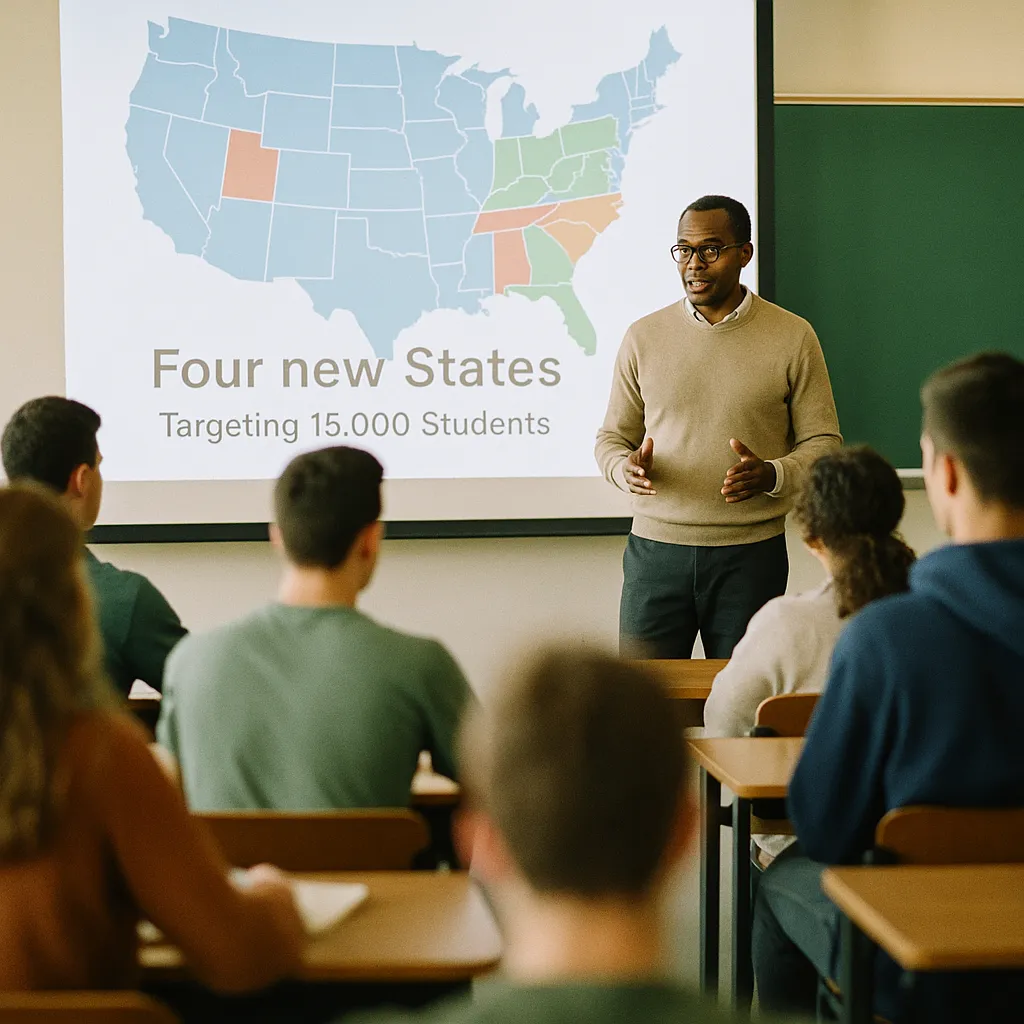
Carnegie Mellon's AI4MiddleSchools is expanding to four new states over three years, targeting 15,000 students and 1,700 educators as districts race to build AI literacy before high school.
Carnegie Mellon's AI4MiddleSchools Expands to Four New States, Targeting 15,000 Students
Carnegie Mellon University's AI4MiddleSchools program is expanding to Connecticut, Mississippi, New Jersey, and Pennsylvania — reaching an estimated 15,000 students and 1,700 educators over three years. The expansion matters because middle school is where students form lasting attitudes toward STEM, and districts across the country are racing to build AI literacy before students arrive at high school without it.
What AI4MiddleSchools Actually Does
AI4MiddleSchools is a multi-state partnership backed by Carnegie Mellon that trains teachers first, then students. The program's premise is that AI literacy won't take hold in classrooms unless educators have deep fluency — not just passing familiarity — with the technology. That means structured cohort training, regional hubs, and ongoing professional learning, not one-day workshops followed by silence.
The program has operated in Georgia, Texas, and Florida before this expansion. The four incoming states represent a mix of policy momentum and underserved districts. Connecticut passed AI-related curriculum guidance earlier in 2026 and has urban districts actively piloting AI tools. Mississippi ranks near the bottom of national STEM attainment metrics and has fewer established pathways for specialized curriculum development. New Jersey and Pennsylvania bring large suburban and urban district networks that could, if the model proves durable, serve as templates for broader Northeastern rollout.
The Numbers
According to Ed Futures by Design, the three-year expansion targets 15,000 students and 1,700 educators across the seven-state footprint. Educators participate in multi-day cohort training and have access to an online professional learning platform delivering updated lesson plans, peer community resources, and AI tool guidance as the technology evolves.
The 1,700 educator figure is the more consequential number. Each teacher in the cohort reaches many more students than any direct student-facing program can reach at this funding level. The multiplier effect of teacher preparation is the core logic behind the program's architecture.
Get this in your inbox.
Daily AI intelligence. Free. No spam.
The Gap It's Filling
A 2026 Digital Education Council survey found an 88-point gap between student AI usage rates and faculty AI readiness. Students are using AI tools routinely — for homework, creative projects, and research. Most of their teachers aren't prepared to contextualize, structure, or evaluate that use. That gap starts forming in middle school, where foundational habits of mind around research, critical thinking, and tool use are still malleable.
The risk of waiting until high school is real. By the time students reach ninth grade, patterns around AI use — whether they treat it as a shortcut, a crutch, or a genuine thinking tool — are already set. Middle school is the intervention window.
What the Expansion Means for Districts
For districts in the expansion states, AI4MiddleSchools represents one of the few structured pathways available to middle school educators outside of individual district initiatives or third-party edtech purchases. Most AI literacy programs are built for high school or college students. Programs calibrated to the 11-to-14-year-old range — where motivation, trust in technology, and institutional learning habits are still forming — are genuinely scarce.
For Connecticut and Pennsylvania districts with existing policy frameworks, the program provides a structured curriculum backbone to align against. For Mississippi districts, it's access to professional development infrastructure that hasn't previously existed at this level locally.
The Mississippi Test Case
Mississippi's inclusion deserves specific attention. State-level AI education resources are minimal, teacher retention in STEM subjects is chronically difficult, and rural geography makes regional hub models harder to sustain. If AI4MiddleSchools demonstrates measurable educator confidence and student outcome gains in Mississippi within the three-year window, the model becomes meaningfully more portable to other states with similar structural challenges.
It also puts pressure on other research institutions to prioritize geographic equity in AI education rollouts rather than concentrating expansion in high-capacity coastal districts that already have more resources.
What to Watch
Three variables will determine whether this expansion creates durable impact or another well-intentioned pilot:
- Teacher retention: Educator turnover in K–12 erases training gains faster than almost any other variable. Whether AI4MiddleSchools builds institutional adoption — state curriculum alignment, principal buy-in, embedded professional learning structures — will determine whether cohort training sticks beyond Year 1
- Outcome data: The three-year timeline should produce learnable benchmarks on student AI literacy and teacher practice change. How that data is published and acted on matters for the broader field
- State policy follow-through: In states like Connecticut where AI education policy is actively evolving, alignment with state curriculum standards will determine how deeply the program embeds versus how easily it gets displaced by the next initiative
This is a concrete, well-structured effort to address a pipeline problem that most AI policy discussions treat as an afterthought. Whether it scales beyond seven states depends on what the data shows — and whether the organizations funding it treat outcome measurement as seriously as launch announcements.
Did this help you understand AI better?
Your feedback helps us write more useful content.
Get tomorrow's AI briefing
Join readers who start their day with NexChron. Free, daily, no spam.