Boston became the first major U.S. city to launch a structured AI literacy graduation requirement for public high schoolers, rolling out AI Educator Ambassadors backed by a $1 million private grant and a curriculum co-developed with UMass Boston.
Boston Launches AI Educator Ambassadors — Building the First Citywide AI Literacy Pipeline for Public High Schoolers
Boston Public Schools launched its inaugural cohort of AI Educator Ambassadors this month, backed by a $1 million private grant and a curriculum co-developed with UMass Boston — making Boston the first major U.S. city to build a structured, city-backed AI literacy pathway tied directly to the high school graduation pipeline.
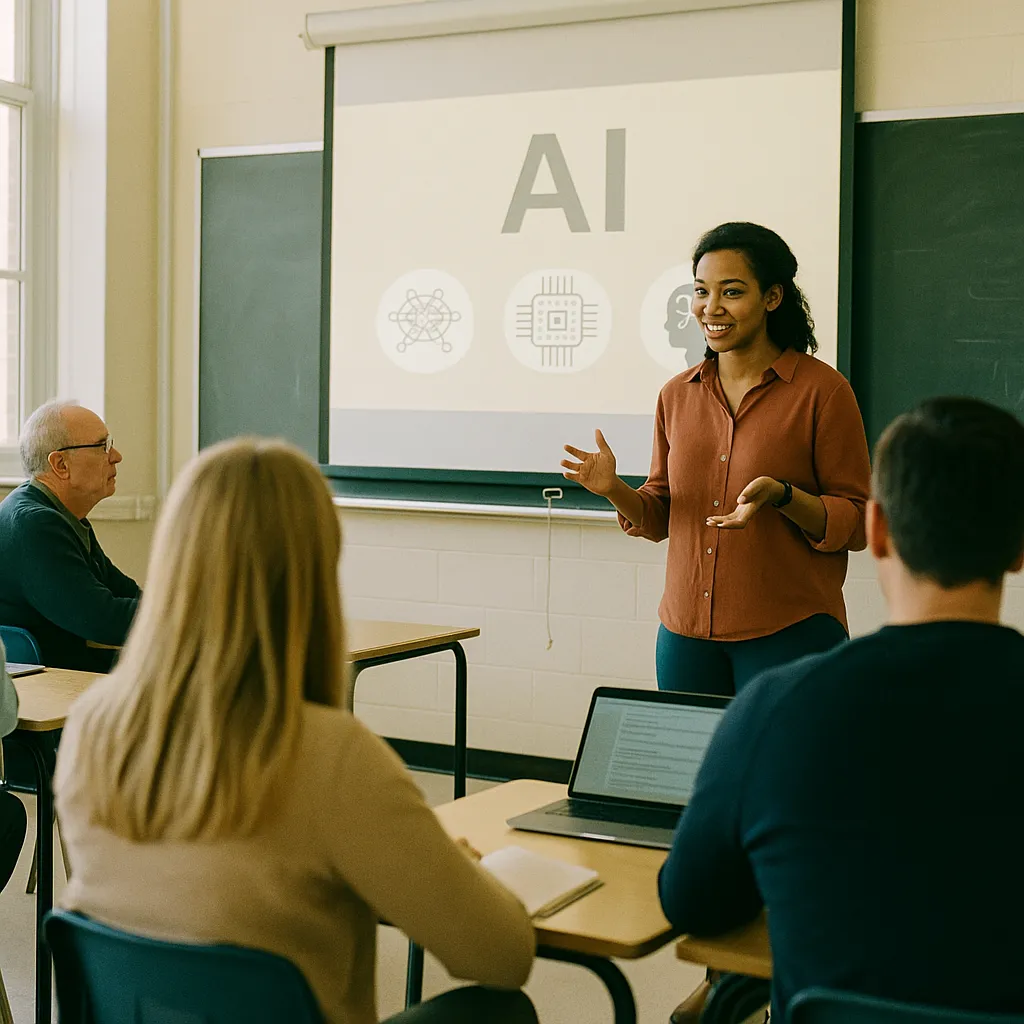
The program moves Boston beyond the ad hoc classroom AI experiments most school districts are still navigating. Mayor Michelle Wu and BPS Superintendent Mary Skipper announced the initiative following a week-long Summer Institute where the first cohort of ambassador teachers received hands-on training before bringing the curriculum into their classrooms this fall.
What the Program Includes
According to Boston.gov, the BPS AI Educator Ambassadors program is built around several concrete components:
- Curriculum foundation: Developed in partnership with UMass Boston, the AI literacy coursework targets high school students and is designed to meet a graduation-level proficiency standard beginning fall 2026.
- Private funding anchor: A $1 million grant from Kayak co-founder Paul English funds the initial implementation phase, allowing the district to move ahead of public budget cycles.
- Career pathways: Beyond classroom instruction, the program connects students to AI-focused hackathons, internships, and career development opportunities — targeting the skills gap at entry point rather than at hire.
- Teacher-first model: The Summer Institute trains ambassador educators first, who then cascade instruction through their schools. This approach scales without requiring a district-wide curriculum overhaul.
The end goal is concrete: every BPS high school graduate should demonstrate AI literacy before earning a diploma.
Why This Is Different
Most U.S. school districts still don't have a formal AI literacy standard. What exists is a patchwork — some teachers using ChatGPT as a classroom aid, some districts banning it outright, a handful of state-level frameworks recommending AI literacy without mandating it. Boston's announcement changes that equation by attaching AI proficiency to the graduation requirement itself.
The city is also choosing a curriculum model built with an academic partner rather than a private EdTech vendor. That distinction matters in a climate where families and educators are increasingly skeptical of vendor-driven AI products targeting children. The UMass Boston partnership lends the curriculum institutional credibility and academic oversight.
Get this in your inbox.
Daily AI intelligence. Free. No spam.
Private funding is another deliberate design choice. The $1 million Paul English grant lets BPS move on a startup timeline rather than waiting for budget appropriations or federal grants. If the program proves its outcomes, the case for public funding becomes much easier to make in subsequent cycles.
The National Context
At the federal level, AI education policy has moved slowly. The Senate held hearings earlier this year on whether AI literacy should be a national curriculum priority, but no binding standards have emerged. State legislatures have passed a wave of AI [education bills](/education/states-regulate-ai-in-classrooms) in 2026, but most remain at the framework stage — calling for pilots or voluntary guidelines rather than graduation requirements.
That gap is exactly what makes Boston's action meaningful. Rather than waiting for Washington or the state legislature, the city is building the pipeline from the classroom up.
The labor market context adds urgency. SHRM's 2026 workforce research finds that 23.2 million [U.S. jobs](/work/goldman-sachs-ai-jobs-gen-z) are already meaningfully impacted by AI — with the most common impact being task automation rather than full role elimination. Workers who understand how to operate alongside AI tools are better positioned than those who don't, and that advantage compounds over a career. Building that literacy at the high school level, before students enter the workforce, is a structural intervention rather than a remediation effort.
What Employers and EdTech Companies Should Know
Companies hiring in Boston or recruiting from BPS career pipelines should expect a generation of graduates with documented AI literacy within the next two to three years. For employers already building AI fluency into job descriptions — and that number is growing fast, with AI skills mentions in job postings up 297% in 2026 — this is a meaningful signal from one of the country's largest urban school systems.
For EdTech companies, the BPS model offers a template that could replicate in other cities if outcomes hold. The ambassador model is notably more sustainable than trying to overhaul district-wide curriculum from the top, and the UMass Boston partnership shows that universities can play a central role in providing the academic scaffolding that vendor-built curricula often lack.
What to Watch
The first real test is fall 2026 implementation: how many BPS high schools have trained Ambassador teachers in classrooms, what the curriculum looks like in practice, and whether the hackathon and internship components develop real employer partnerships or remain aspirational. BPS will need to track student outcomes — AI fluency assessments, career placement rates, college enrollment in tech-adjacent programs — to make the case for scaling. Boston's results over the next 12 months will either create a replicable national model or expose the structural limits of city-level AI education initiatives working without federal support.
By Hector Herrera
Did this help you understand AI better?
Your feedback helps us write more useful content.
Get tomorrow's AI briefing
Join readers who start their day with NexChron. Free, daily, no spam.