Over 400 Berklee students petitioned to remove an AI songwriting elective. The authorship anxiety is real. Removing the course is the wrong response to it.
400 Berklee Students Petition Against AI Songwriting Class — and It's the Wrong Fight
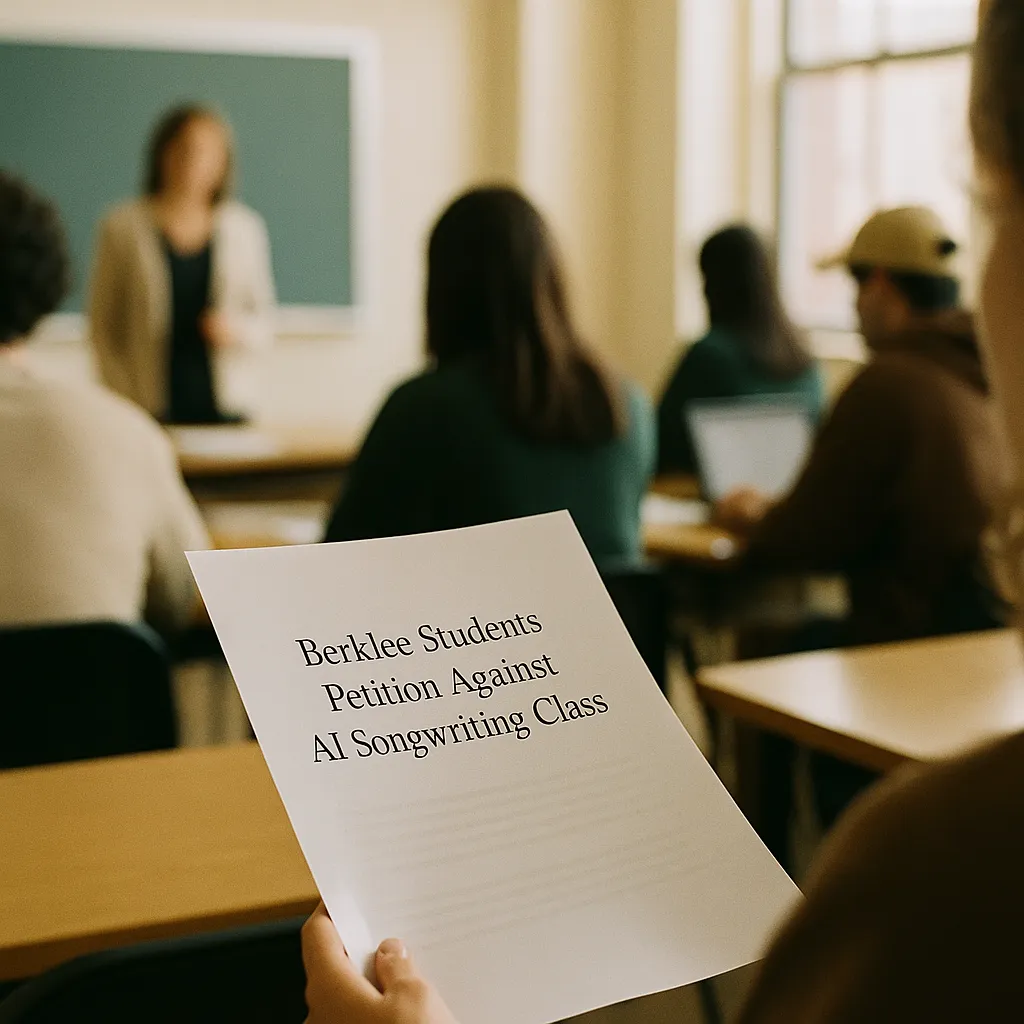
More than 400 students at Berklee College of Music signed a petition demanding the removal of AI generative music tools and an AI songwriting elective from the curriculum, according to WBUR's reporting. The pushback is understandable. It is also almost certainly counterproductive — and it surfaces a question every arts education program in the world is going to face in the next two years.
Context
Berklee is the most influential popular music college on earth. Its alumni wrote, performed, produced, or mixed a significant share of what you consider the modern pop and jazz canon. When Berklee moves, music education globally takes notice.
The petition targets generative AI tools — software like Suno, Udio, and their successors that can produce commercially viable music from text prompts — and an elective course that teaches students to use these tools in songwriting workflows. The student argument, consistent with creative-industry resistance to generative AI broadly, centers on authorship: if an AI generates the melody, the chord progression, or the arrangement, what exactly is the student learning? What is the human contribution? And who owns what comes out?
These are legitimate questions. The petition is not an irrational document. But the conclusions it draws from those questions — remove the tools, remove the course — reflect a misunderstanding of what the threat actually is.
The Authorship Question
The petition frames AI music tools as threats to craft. The concern is that students will use AI to generate music rather than learning to write it — that the tool will become a substitute for the underlying skill rather than an extension of it.
This concern has a historical analogue: the same argument was made about sequencers in the 1980s (they'd eliminate drummers), audio workstations in the 1990s (they'd eliminate arrangers), and autotune in the 2000s (it'd eliminate the need to sing in tune). Each technology changed the craft. None eliminated it. The musicians who mastered the new tools while retaining command of the underlying discipline became the most in-demand creators of their generation.
The distinction matters: AI music tools are not generating finished, commercially viable records from a single prompt. What they're doing — in professional workflows — is compressing the time between an idea and a rough version of it. A songwriter who can hum a chord progression and have a working demo in twenty minutes has more time to evaluate, refine, and iterate on ideas than one who spends four hours programming the same demo from scratch. That's a workflow change. It's not an authorship replacement.
Get this in your inbox.
Daily AI intelligence. Free. No spam.
The deeper authorship question — who owns the output — is genuinely unsettled legally and ethically. But that question is more urgently answered by students who understand how the tools work than by students who have never touched them.
What's Actually Being Lost
The more substantive concern buried in the Berklee petition isn't about AI replacing student creativity — it's about the music industry collapsing the economic floor for working musicians. That argument has merit.
Streaming platforms are already testing AI-generated background music that costs nothing to license and crowds out catalog placements for human artists. Game companies are experimenting with procedurally generated soundtracks that don't require music supervisors or composer fees. Ad agencies are using AI music tools to generate custom tracks for clients in hours rather than paying for sync licenses or custom compositions.
These are real economic threats to the careers Berklee graduates expect to build. They're not threats that a curriculum change at one college will address — because the companies deploying these tools aren't waiting for academic consensus. But they are the conversation that deserves to be happening inside the petition.
The Wrong Battle
Removing an AI songwriting elective from Berklee's curriculum means graduating musicians who enter a music industry already transformed by AI without ever having worked with the tools shaping it. Those graduates will be less equipped to make professional judgments about when to use AI tools, how to retain authorship and legal ownership of AI-assisted work, and how to compete with and differentiate from AI-generated content.
The institutions whose graduates are best positioned in the next decade will be those that taught both: the foundational craft of music — theory, ear training, arrangement, performance — and the professional competency of working with AI tools as an instrument in the workflow, not a substitute for one.
The fight over an elective is a proxy for a much bigger anxiety: that the economic and creative ground is shifting faster than the curriculum can adapt, and that the industry students are training to enter will look fundamentally different by the time they graduate. That anxiety is valid. The petition is the wrong response to it.
What to Watch
Whether Berklee's administration holds the course offering will signal how elite music education programs globally resolve this conflict. More consequential is whether the curriculum — AI elective or not — actually teaches the authorship and legal ownership frameworks students need to navigate an industry where human-AI collaboration is becoming the commercial standard, not the exception.
By Hector Herrera | NexChron | April 29, 2026
Did this help you understand AI better?
Your feedback helps us write more useful content.
Get tomorrow's AI briefing
Join readers who start their day with NexChron. Free, daily, no spam.