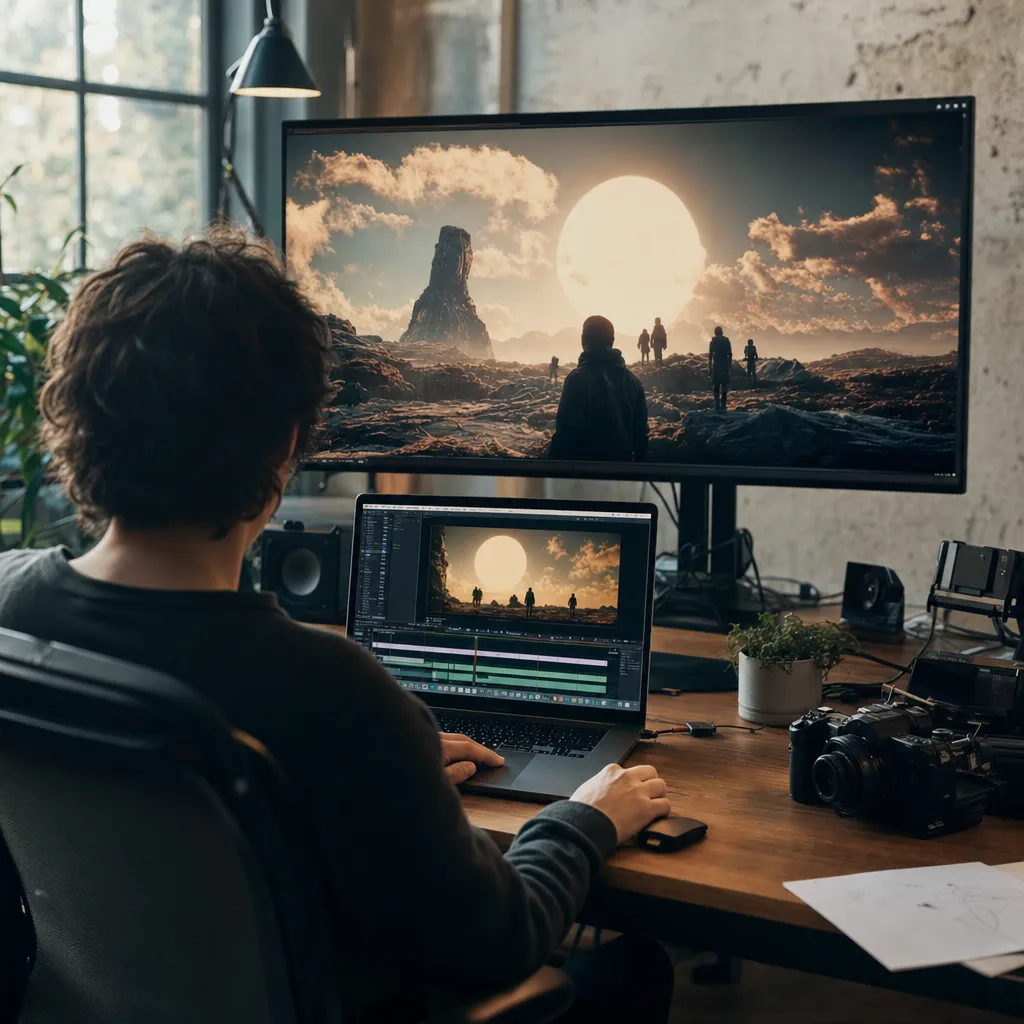
Jenny Krakovsky completed Boss, a female-led crime caper set in 1960s Liverpool, using AI filmmaking tools on a laptop for £17,000 in 50 days — and is now pursuing commercial theatrical release.
A London director has completed a feature-length film — a female-led crime caper set in 1960s Liverpool — using only AI filmmaking tools, in 50 days, on a laptop, for £17,000. Jenny Krakovsky's Boss is now pursuing commercial theatrical release. The production is the most rigorous test yet of whether AI-made feature films can cross the distribution threshold that separates experiment from industry disruption.
The numbers are the point. An independent UK feature of comparable genre ambition typically costs between £500,000 and £2 million, takes 18 to 36 months from development to screen, and requires a crew of dozens. Boss used one director, a consumer laptop, AI generation tools, and a budget that most aspiring filmmakers could theoretically access. According to The Call Sheet, Suno — the AI music generation platform — produced the film's Merseybeat soundtrack, the period-authentic music that in conventional production would require session musicians, a music supervisor, and significant licensing costs.
What Krakovsky Made
Boss is a female-led crime caper set in 1960s Liverpool — a period and genre that conventionally demands significant production design investment. Street dressing, period-accurate costumes, set construction, location permits, and hair and makeup work are among the highest per-day costs in low-budget British indie production. Krakovsky's use of AI image and video generation removes most of those costs while introducing a different creative constraint: the director works within what the AI tools can generate and iterate toward, rather than what a physical production could build and shoot.
The 1960s Liverpool setting is a meaningful creative test. Merseybeat culture — the fashion, the street texture, the specific visual energy of early 1960s Britain — is specific enough that generic AI generation fails at it. Krakovsky's 50-day production timeline included the iterative refinement work of pushing AI outputs toward a coherent period visual language, not simply accepting first-generation results. That work is invisible in the budget number but represents the core directorial craft the film required.
The soundtrack via Suno produced original music in the Merseybeat style — upbeat guitar pop with the Liverpool accent that defined popular culture across early 1960s Britain and exported worldwide through the Beatles. Using Suno rather than licensed period recordings eliminates music clearance costs entirely while producing original music that fits the film's specific creative requirements. This is one of the clearest demonstrations of AI music tools providing commercial value: not replacing a musician's creativity but eliminating the licensing cost structure that makes period-authentic music unaffordable for low-budget productions.
The Distribution Question
Boss's theatrical ambitions are where this production becomes a genuine industry data point rather than a technical demonstration. AI-generated short films and experimental work have screened at festivals for several years. AI-assisted features — films using AI tools for specific visual effects sequences — have reached streaming distribution. Boss, if it reaches commercial theatrical release, would be the first fully AI-generated feature to do so.
Get this in your inbox.
Daily AI intelligence. Free. No spam.
The barriers are real but not, in principle, about AI provenance. Cinema booking agents, distributors, and exhibition chains evaluate films on visual consistency, audio quality, narrative coherence, and audience appeal — not on production method. An AI-generated film that clears those quality thresholds changes the economic argument for traditional production in ways that studios, streamers, and distributors have not yet fully priced in.
The UK film ecosystem may be the right market for this test. British independent cinema has a higher tolerance for formally unconventional work than most markets, BFI funding creates infrastructure for low-budget theatrical releases, and the network of independent cinemas maintains an audience for films that bypass multiplex economics. The 1960s Liverpool setting also has obvious domestic cultural resonance that could generate interest independent of the film's AI production origin.
What This Means for Independent Film
The immediate implication is not that AI will replace traditional film production. It is that the cost floor for feature filmmaking has dropped by an order of magnitude, and the question of what that produces is now empirical rather than theoretical.
For screenwriters, directors, and producers who have been locked out of feature development by capital requirements, Boss is a proof of concept. The £17,000 price point is within reach of a motivated individual with a day job and savings — not a lottery ticket requiring a development deal.
For the studios, streamers, and distributors who control distribution infrastructure, the prospect of AI-generated features entering the market at this cost creates a curation and quality-signal problem. How do you distinguish the films worth releasing from the noise when the barrier to completing a feature drops this far?
The economics of independent filmmaking were already under structural pressure from streaming compression of theatrical windows and the collapse of mid-budget production. AI-generated features entering the market at £17,000 per unit intensify that pressure in ways that are not yet worked out.
What to Watch
The outcome of Boss's pursuit of theatrical distribution is the immediate data point. A commercial theatrical release — even limited, even a single-screen run — establishes a precedent. A rejection from distributors on quality grounds establishes a different precedent: a benchmark for what the current generation of AI film tools can and cannot achieve at feature length.
The second metric to watch is critical and audience response if the film screens publicly. Short-form AI video has found audiences. Whether a 90-minute AI feature sustains narrative attention and emotional engagement — the specific things that separate films from demos — is a question that Boss may be the first to answer at commercial scale.
Did this help you understand AI better?
Your feedback helps us write more useful content.
Get tomorrow's AI briefing
Join readers who start their day with NexChron. Free, daily, no spam.