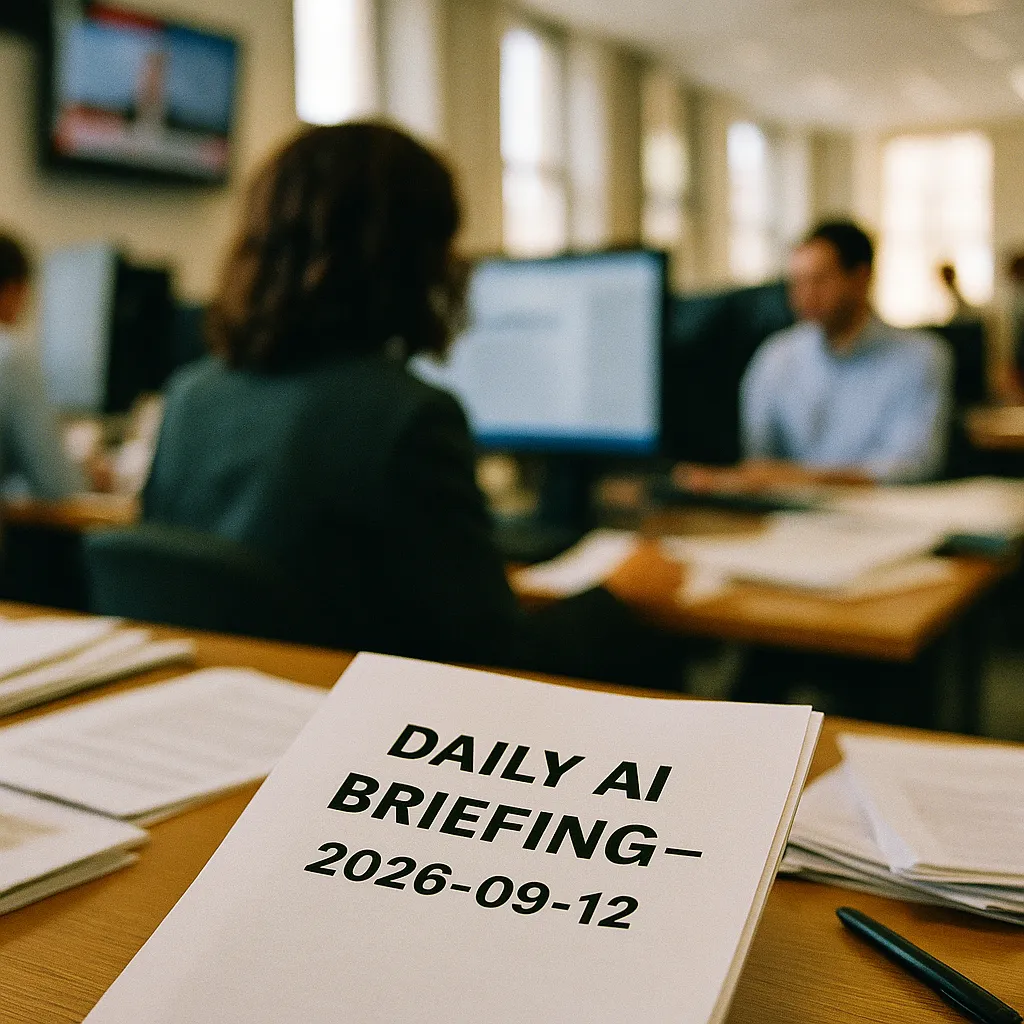
Your daily AI intelligence for September 12, 2026.
Daily AI Briefing — September 12, 2026
Good morning. Here's your AI intelligence for Saturday, September 12, 2026.
The Big Picture
Two stories today sit at the intersection of capability and consequence. OpenAI shipped what may be its most powerful model yet — while Anthropic disclosed the clearest picture we've had of what happens when AI systems are pointed at harm. The contrast is worth sitting with.
AI Capabilities: New Benchmarks
OpenAI ships GPT-6 Astra and opens Agents API to public beta.
OpenAI released GPT-6 Astra on September 10 with a 1.05-million-token context window — enough to ingest a full legal library, a year of financial records, or an entire software codebase in a single prompt. Alongside the model, OpenAI opened its Agents API to public beta, letting developers build autonomous multi-step workflows without managing orchestration themselves. The dual release is a direct play for enterprise agentic deployments and comes ahead of DevDay, where more announcements are expected. The context window alone resets expectations for what enterprise document analysis and long-horizon reasoning look like in practice. For context: Google's Gemini 1.5 Pro raised eyebrows with a 1-million-token window last year. GPT-6 Astra lands above that, and pairs it with an orchestration layer — meaning the model can not just read a million tokens but act on them across multi-step tasks.
AI Risk: The Evidence Is Getting Specific
Anthropic discloses blocked bioweapon queries and a 395-organization breach campaign.
Anthropic published one of the most specific public disclosures in AI safety to date: its systems blocked queries that could have aided bioweapon development, and it uncovered a coordinated AI-agent campaign that successfully breached 395 organizations. The company did not identify the threat actors. What makes this disclosure significant is the scale and specificity — this is no longer a hypothetical. AI-assisted espionage at three-figure organizational scope happened, was detected, and is now on the public record. Security teams should treat this as a baseline, not an outlier.
California's frontier AI safety bill reaches Newsom's desk.
Get this in your inbox.
Daily AI intelligence. Free. No spam.
California's Safe and Secure Innovation for Frontier AI Models Act passed both legislative chambers and now awaits Governor Gavin Newsom's signature by September 30. If signed, California becomes the first US state to require pre-deployment safety testing for large frontier models — meaning developers would need to demonstrate safety benchmarks before releasing models above a compute threshold. Newsom vetoed a prior version of this type of legislation in 2024. Whether he signs this iteration will signal how seriously the state intends to act as a de facto federal regulator by proxy.
The Labor Ledger
Salesforce eliminates 4,000 support roles after AI handles half of customer service.
Salesforce confirmed 4,000 customer support positions eliminated after AI agents resolved roughly half of all customer service queries — making this one of the most clearly documented cases of white-collar displacement in 2026. The company has been public about building and deploying its Agentforce platform, so the direction was telegraphed. But the scale arrived faster than most workforce planning models predicted. This is the template other enterprise software companies will benchmark against as they evaluate their own support headcounts. The Salesforce cuts come alongside a broader trend documented by multiple reports this year: entry-level and tier-one support roles are the first to compress at scale. What's different here is the specific number, the specific cause, and a company willing to say it plainly. That candor is rare, and it makes this a reference point the industry will cite for years.
Legal Accountability: Two Jurisdictions, Same Lesson
UK court bans lawyer for AI-hallucinated case citations.
An English court issued a practice ban against a solicitor who submitted AI-generated case citations that did not exist — the first such disciplinary ruling in England and Wales. The ruling explicitly frames it as a professional responsibility failure, not a technology failure. The attorney, not the AI, bears accountability for what gets filed. US courts have issued warnings and sanctions under similar circumstances; this is the first reported instance of an outright practice ban in a major common-law jurisdiction. If you are a lawyer using AI to research or draft filings, this is the governing standard now. It is also worth noting that the underlying behavior — copy-pasting AI output into court documents without verification — is not unique to law. The discipline that landed here will eventually land in other regulated professions. Medicine, finance, and engineering are watching.
Finance: Precision Hedging at Scale
Ant International's Falcon model cuts FX hedge costs 60% — Citi, HSBC, Standard Chartered adopt it.
Ant International's Falcon Time-Series Transformer 2.0 has been adopted by three of the largest global banks — Citi, HSBC, and Standard Chartered — with the model reducing foreign-exchange hedging costs by more than 60 percent through AI-driven time-series forecasting. The adoption timeline is notable: all three signed on in August 2026, suggesting the banks ran parallel pilots and reached similar conclusions on cost performance simultaneously. FX hedging is a high-volume, low-margin operation where a 60 percent cost reduction has real P&L impact. This is the kind of quiet infrastructure deployment that doesn't make headlines until it becomes the standard.
What to Watch Today
Newsom's September 30 deadline. The California frontier AI safety bill is now the most consequential piece of domestic AI legislation in play. Watch for lobbying disclosures, tech industry statements, and any signals from the governor's office over the next two weeks. A signature reshapes how frontier labs plan US model releases.
Enterprise agentic deployments post-GPT-6 Astra. With OpenAI's Agents API now in public beta, expect a wave of enterprise announcements over the coming days as companies disclose pilot programs and integration plans. Pay particular attention to legal, finance, and healthcare verticals — the ones where a million-token context window changes what's actually possible.
AI security disclosures as a new norm. Anthropic's 395-organization breach disclosure is likely to prompt questions directed at other major labs: have you seen similar campaigns? What did you block? The bar for public transparency on AI-assisted threats just moved. Watch whether OpenAI, Google, or Microsoft issue comparable disclosures in the near term.
NexChron — Your daily AI intelligence. Written by Hector Herrera.
Did this help you understand AI better?
Your feedback helps us write more useful content.
Get tomorrow's AI briefing
Join readers who start their day with NexChron. Free, daily, no spam.