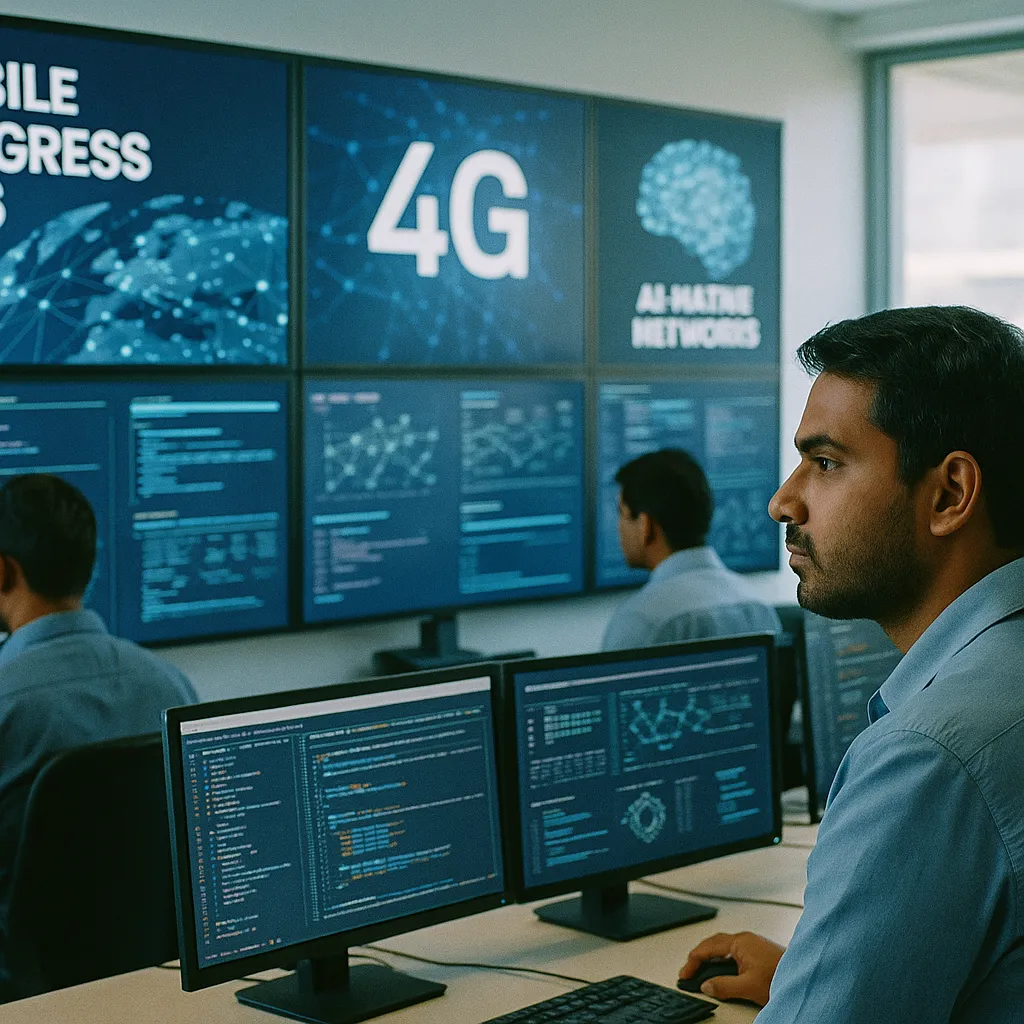
India Mobile Congress 2026 opened today in New Delhi with 6G architecture and AI-native network management as the headline topics — backed by a pressing commercial case.
India Mobile Congress 2026 — the world's largest telecom event by country footprint — opened today in New Delhi with a commercial urgency at its center: India's mobile operators are handling 25% more traffic than last year and earning 11% less revenue per gigabyte delivered. AI-optimized networks are the industry's proposed answer.
Why it matters: India has over 1.1 billion mobile subscribers and hosts two carriers — Reliance Jio and Airtel — that have shaped global telecom infrastructure investment for a decade. What IMC 2026 endorses, the global telecom equipment industry builds.
The event
India Mobile Congress 2026 (IMC 2026) opened October 7 at Yashobhoomi, New Delhi, under the theme "Scale Without Boundaries," according to Business Standard. Prime Minister Narendra Modi is scheduled to inaugurate the four-day event October 8.
The conference headline topics:
- 6G architecture — design specifications for the next mobile generation, targeting commercial deployment in the early 2030s
- AI-native network management — using AI to optimize spectrum allocation, traffic routing, and predictive maintenance in real time
- Autonomous network operations — reducing human operator involvement in routine network management decisions
- Satellite communications — low Earth orbit integration with terrestrial 5G networks for rural coverage
The data paradox problem
The commercial pressure underlying IMC 2026 is uncomfortable and well-documented. Mobile data traffic in India has grown 25% year-over-year, driven by video streaming, AI-powered applications, and expanding 5G coverage. Revenue per gigabyte has fallen 11% as carrier price competition pushes floors downward.
This ARPU compression — Average Revenue Per User declining even as usage climbs — is a structural problem that more towers and more spectrum alone cannot solve. Traditional network expansion adds cost without proportionally adding revenue. What the industry needs is to operate existing infrastructure more intelligently.
AI-optimized network management offers a different path:
Get this in your inbox.
Daily AI intelligence. Free. No spam.
- Predictive congestion management — anticipating traffic spikes before they hit and routing around them
- Dynamic spectrum allocation — redistributing spectrum between cells in real time based on actual demand
- Energy optimization — powering down underutilized cells during low-demand periods to cut electricity costs
- Fault prediction — identifying equipment likely to fail before it causes outages
For carriers under margin pressure, these applications translate directly to cost reductions that don't require new spectrum licenses or tower construction.
Why 6G is an AI architecture question
In prior mobile generations, "G" referred primarily to radio technology: spectrum bands, transmission protocols, and antenna configurations that determine speed and coverage. 6G is being designed with AI as a component of the network architecture itself — not an add-on feature, but a structural design requirement embedded in the 6G standards being written now.
An AI-native 6G network can theoretically manage itself: detecting interference, reallocating spectrum, routing traffic, and provisioning capacity without human operator intervention for routine decisions. The architecture choices made at conferences like IMC 2026 — in standards bodies, government consultations, and supplier negotiations — will determine how much of that autonomy becomes real when 6G deploys commercially.
India's scale means its specifications influence what global equipment vendors build. NVIDIA's 6G AI-native architecture research, released earlier this year, described the architectural requirements for AI-native networks; IMC 2026 is where carriers and vendors negotiate which of those requirements become procurement standards.
Equipment vendors at IMC 2026
Nokia, Ericsson, and Huawei are all demonstrating AI-managed RAN (Radio Access Network — the part of a cellular network that connects mobile devices to base stations) systems at IMC 2026. Each offers a different model for the degree of autonomy:
- Nokia is demonstrating Self-Organizing Network (SON) AI for automated network configuration and optimization
- Ericsson is showing AI-driven energy optimization and predictive maintenance applications
- Huawei — present despite market restrictions in some Western markets — is demonstrating full autonomous network management systems targeting Asian and emerging market carriers
TM Forum's 2026 framework on AI agent authority limits in telecom, released earlier this month, defined the thresholds carriers should set on AI network management autonomy — a practical framework for how much automation can be claimed as commercially deployable today versus aspirational.
The satellite dimension
IMC 2026's satellite sessions reflect the active licensing activity of both Jio and Airtel in 2025-2026. Both carriers hold low Earth orbit (LEO) satellite licenses and are testing satellite-terrestrial hybrid connectivity for rural India, where terrestrial 5G deployment is economically difficult across 1.3 million square miles of varied geography.
AI-managed handoff between terrestrial and satellite connections — routing traffic to the most cost-effective available link without degrading user experience — is a specific Indian requirement. Rural coverage is politically essential in India, and satellite AI integration is the technically viable path to reach markets where tower economics don't work.
What to watch
Prime Minister Modi's October 8 inauguration — past IMC inaugurations have coincided with spectrum auction announcements or major infrastructure investment commitments. Watch for:
- New spectrum auction timelines and band allocations
- Government investment pledges for rural 5G or satellite connectivity programs
- India's official 6G trial timeline (currently targeting 2030 for initial trials)
- Announcements on domestic AI chip or 6G equipment production initiatives
A revision to India's 6G timeline — or formal confirmation of the 2030 target — would carry significant supply chain implications for the global telecom equipment industry, given India's scale as a deployment market and its leverage over vendor pricing and product roadmaps.
Source: Business Standard — India Mobile Congress 2026 Begins Oct 7 with 6G, AI, Cybersecurity in Focus
Did this help you understand AI better?
Your feedback helps us write more useful content.
Get tomorrow's AI briefing
Join readers who start their day with NexChron. Free, daily, no spam.