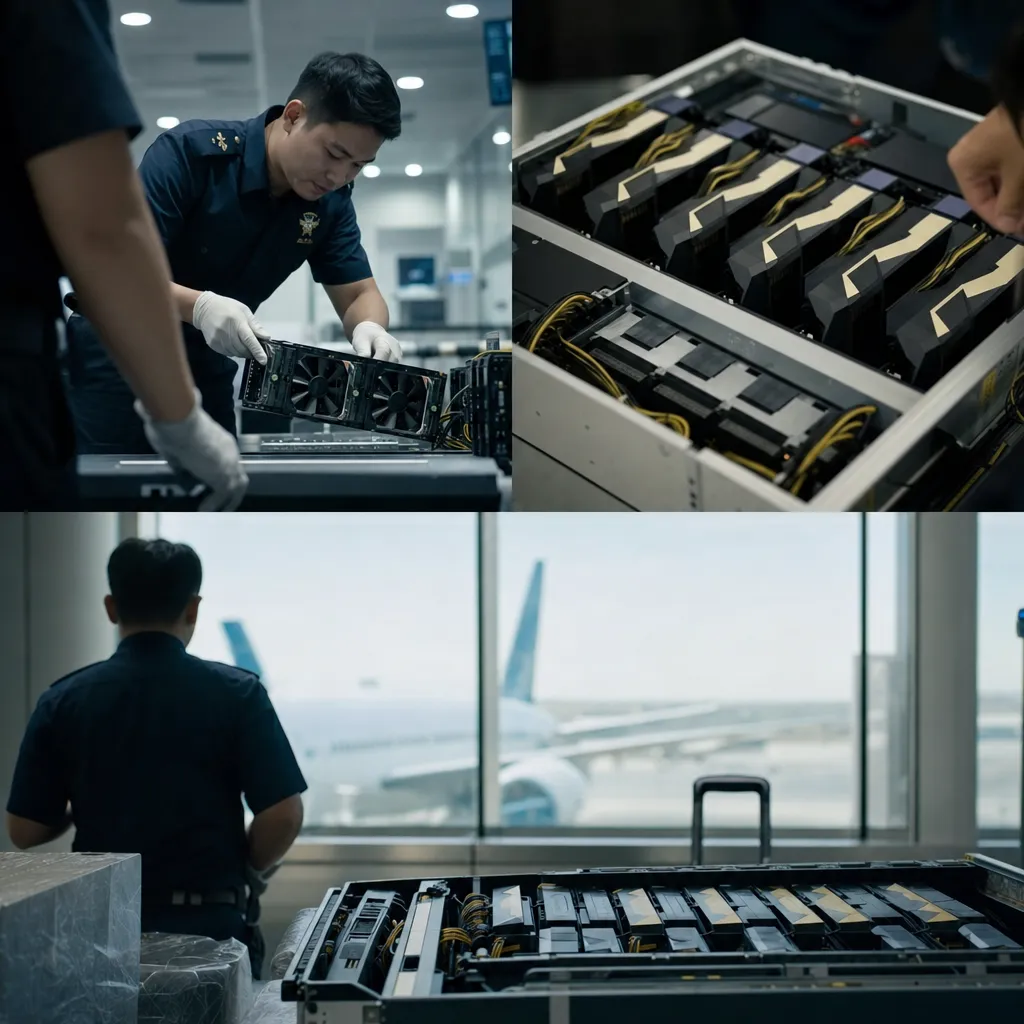
Malaysian customs seized $12.1 million in advanced AI chips concealed inside 30 servers at KLIA — the fifth interception this year of restricted U.S. semiconductors being routed toward China.
Malaysian customs authorities seized $12.1 million worth of advanced AI chips hidden inside 30 server units at Kuala Lumpur International Airport, the country's fifth interception this year of restricted semiconductors being routed toward China. The scale of the operation — and the fact that it keeps happening — signals that U.S. export controls on AI hardware are creating a sustained black market, with Malaysia as a preferred transit corridor.
U.S. export restrictions on advanced AI chips, primarily Nvidia's H100 and A100 series, bar their sale to China without a license. The rules, tightened repeatedly since 2022, are meant to slow China's development of military AI applications and frontier models. The gap between what China can legally buy and what it needs to build competitive systems has created economic incentives large enough to sustain a smuggling syndicate across multiple years.
What Happened
According to Reuters, the chips were declared as ordinary electronic components intended for re-export. Customs officers flagged the shipment for inspection; the actual contents — advanced AI accelerators — were not listed on the export permits accompanying the cargo.
Key facts:
- Value of this seizure: $12.1 million
- Units searched: 30 servers
- Location: Kuala Lumpur International Airport (KLIA)
- Year-to-date seizures: Five incidents; combined value exceeds $24 million
- Suspected syndicate: Investigators believe a single organization is coordinating shipments through Malaysia as a re-export hub
The chips had no permits for export to their declared destination. Malaysian law requires export licenses for strategic goods including high-performance semiconductors.
Get this in your inbox.
Daily AI intelligence. Free. No spam.
Why Malaysia
Malaysia sits between major chip manufacturing hubs (Taiwan, South Korea) and final destinations in Southeast Asia, making it a logical transshipment point. The country is also a significant legitimate hub for electronics trade, which creates cover: a large volume of real semiconductor traffic provides camouflage for illicit cargo.
The U.S. Commerce Department has previously flagged Malaysia as a country of concern for chip diversion. In 2023 and 2024, the department added several Malaysian entities to its export restriction lists after evidence emerged that U.S.-origin chips were reaching Chinese buyers through Malaysian intermediaries.
What This Means
For U.S. export policy: Five seizures totaling $24 million in a single year at one airport suggests the enforcement net is catching a fraction of actual volume. Customs interceptions are, by definition, the failures of the smuggling operation — successful transshipments go undetected. The Biden and Trump administrations both increased enforcement resources at foreign ports, but the incentive structure favors the smugglers: the profit margin on a successfully delivered H100 cluster justifies significant operational risk.
For the AI industry: Chip scarcity in China — legal or otherwise — affects the competitive landscape. Chinese AI labs building frontier models face genuine hardware constraints that U.S. competitors do not. Black-market chips reduce, but do not eliminate, that gap.
For Malaysia: Repeated interceptions put pressure on the government to demonstrate stronger enforcement or risk secondary sanctions from the United States. Malaysia's trade relationship with the U.S. is substantial; the diplomatic cost of being seen as a permissive transit hub is real.
What to Watch
Whether U.S. officials respond to the fifth seizure with additional diplomatic pressure on Kuala Lumpur, and whether any arrests connect to a larger network rather than isolated opportunists. The $24 million figure is also almost certainly an undercount — watch for a Commerce Department or BIS report on Malaysia's compliance posture in the coming months.
Did this help you understand AI better?
Your feedback helps us write more useful content.
Get tomorrow's AI briefing
Join readers who start their day with NexChron. Free, daily, no spam.