OpenAI pushed 722 mathematics manuscripts to GitHub under Apache 2.0, crediting an unnamed internal frontier model — days after Anthropic's Riemann zeta announcement sparked an open AI math race.
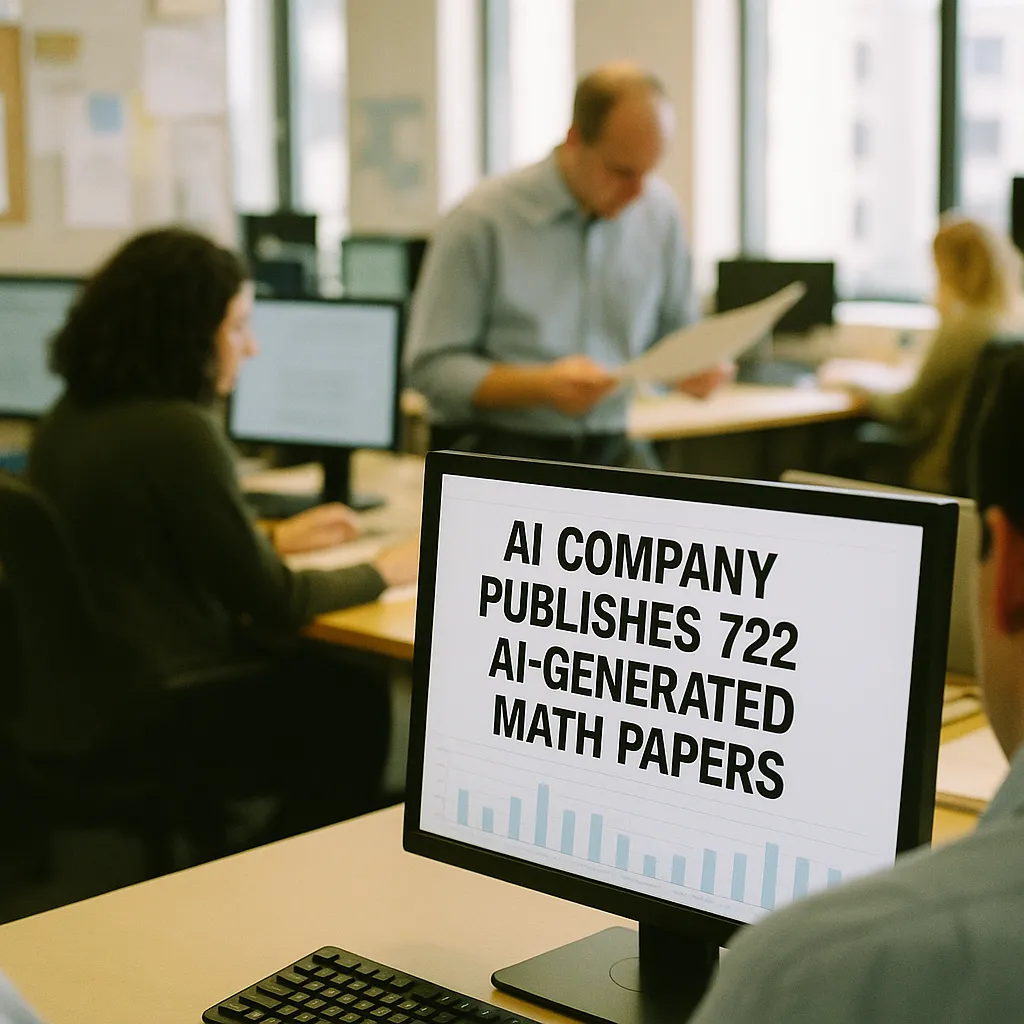
OpenAI pushed 722 mathematics manuscripts to a public GitHub repository on October 6, crediting the work to an internal frontier model it has neither named nor released publicly. The release drops under an Apache 2.0 license, making every result immediately usable by researchers and developers without restriction.
The move came within days of Anthropic reporting that Claude — deployed as an orchestrator over 60 AI subagents — raised the Riemann zeta function lower bound from 41.6% to 67.2%. Two leading AI labs are now openly publishing AI-generated mathematical work in rapid succession. A competitive race to establish AI-driven mathematical credibility is underway, and open GitHub publication is the chosen arena.
What's in the Repository
According to Tech Insider's reporting, the 722 manuscripts are organized into 372 families of related results — suggesting the underlying model was generating mathematically coherent clusters of work rather than isolated outputs. The organization into families is notable: it implies the model maintained structural awareness of how individual results relate to each other, which is a harder task than producing standalone theorems.
The manuscripts span mathematical topics not yet fully catalogued by the research community, and OpenAI has not provided a summary of which subfields are covered. That information will emerge as mathematicians work through the repository.
The Apache 2.0 license is consequential. It permits:
Get this in your inbox.
Daily AI intelligence. Free. No spam.
- Commercial use without restriction
- Modification and distribution of the work
- No copyleft obligations on derived work
That is a deliberate choice. OpenAI is not simply sharing results — it is making AI-generated mathematics a building block for commercial and academic products without friction.
The Unnamed Model
OpenAI attributed the manuscripts to an internal model without identifying it. The company has not announced the model's architecture, training approach, or release timeline. Releasing the outputs before releasing — or even naming — the model is an unusual sequence that raises questions the company has not yet answered publicly:
- Is this a version of GPT-6 or a separate research model?
- What were the verification procedures before public release?
- Why publish outputs now if the model isn't ready for release?
The unnamed-model framing may be strategic — establishing a publication record and inviting community verification before committing to a product timeline.
A Two-Lab Math Race
The back-to-back releases from Anthropic and OpenAI are not coincidental in timing. Both companies are working to establish that their frontier models can contribute to formal mathematics, a domain where AI has historically struggled with precision and hallucination. Progress here carries symbolic weight — it signals that AI systems are approaching a level of reasoning reliability that matters to scientists and engineers, not just to users of consumer applications.
The stakes are practical as well as reputational. AI systems capable of generating novel, verifiable mathematics could accelerate work in cryptography, physics simulation, drug discovery, and materials science. Mathematical results also provide something rare in AI output: a clear verification standard. Either a proof is correct or it isn't. That property makes mathematics a cleaner proving ground than most other AI application areas.
What to Watch
Whether the academic mathematics community engages seriously with the 722 manuscripts will determine how much this release matters. Community verification is the bottleneck — an AI claim to mathematical novelty is only as good as the peer review it survives. If independent mathematicians find errors at scale, the reputational math cuts both ways. If the results hold, the unnamed model will become very named very quickly.
Did this help you understand AI better?
Your feedback helps us write more useful content.
Get tomorrow's AI briefing
Join readers who start their day with NexChron. Free, daily, no spam.