Anthropic researchers deployed Claude over 60 specialized AI subagents to push the Riemann zeta function lower bound from 41.6% to 67.2% — the first verifiable AI contribution to one of mathematics' oldest unsolved problems.
Anthropic researchers have used Claude as an orchestrator over 60 specialized AI subagents to push the Riemann zeta function lower bound from 41.6% to 67.2% — the first verifiable, peer-checkable AI contribution to one of the most consequential unsolved problems in mathematics. The result, published with full methodology for independent review, signals that AI is no longer just accelerating known research pathways but is opening genuinely new ones.
The Riemann Hypothesis, posed by Bernhard Riemann in 1859, predicts that all non-trivial zeros of the Riemann zeta function lie on a specific line in the complex plane. Proving or disproving it would resolve deep questions about how prime numbers distribute across the number line — questions that underpin modern cryptography, number theory, and large swaths of theoretical physics. The Clay Mathematics Institute lists it among its seven Millennium Prize Problems, each carrying a $1 million award. After 167 years, no human mathematician has solved it. AI just moved the goalpost.
What the System Did
According to Anthropic's research team, Claude was deployed not as a single model but as an orchestration layer managing 60 specialized subagents, each assigned to a distinct class of mathematical approach. The system tested 650 distinct strategies in parallel — a scale of simultaneous mathematical exploration no human team could replicate — before converging on a pathway that raised the lower bound on the proportion of Riemann zeta zeros confirmed to lie on the critical line from 41.6% to 67.2%.
That jump of roughly 25 percentage points represents significant mathematical progress by any standard. The prior bound of 41.6% had stood for years, produced through painstaking human computation. The new result was generated, verified, and published in a fraction of that time.
Get this in your inbox.
Daily AI intelligence. Free. No spam.
Critically, Anthropic published the full methodology under open review — the result is not a black-box output but a documented proof pathway that independent mathematicians can check, challenge, and build on. That peer-checkability is what separates this from AI-generated mathematical claims that have circulated without verification.
The Second Finding
The same multi-agent system, operating across separate biological datasets, independently identified a novel CRISPR-like enzyme family — an entirely different domain from number theory. That cross-domain performance in a single research session is the detail that matters most to scientists watching this space. The Riemann result demonstrates mathematical depth; the enzyme finding demonstrates that the architecture generalizes.
CRISPR-like enzymes are of significant commercial and medical interest because they enable precise gene editing. A new enzyme family could expand the toolkit available to researchers working on genetic medicine, agriculture, and industrial biotechnology.
What This Changes
AI has been useful in mathematics for years — verifying known proofs, searching for counterexamples, generating conjectures. But contributing a novel, verifiable advance on an unsolved problem is a different category of capability. It has implications beyond mathematics:
- Scientific research cycles may compress significantly if multi-agent AI can explore hundreds of approaches simultaneously where human researchers explore one or two.
- Attribution and authorship norms in academic publishing are not designed for AI co-contributors. This result will accelerate a conversation the field has been avoiding.
- The Millennium Prize conditions were written for human proofs. Whether an AI-assisted advance qualifies for the prize — or on what terms — is unresolved.
The Riemann result is a lower bound improvement, not a full proof. The hypothesis remains unproven. But the trajectory of the lower bound rising from 41.6% to 67.2% in one compute session suggests the ceiling is not fixed.
What to Watch
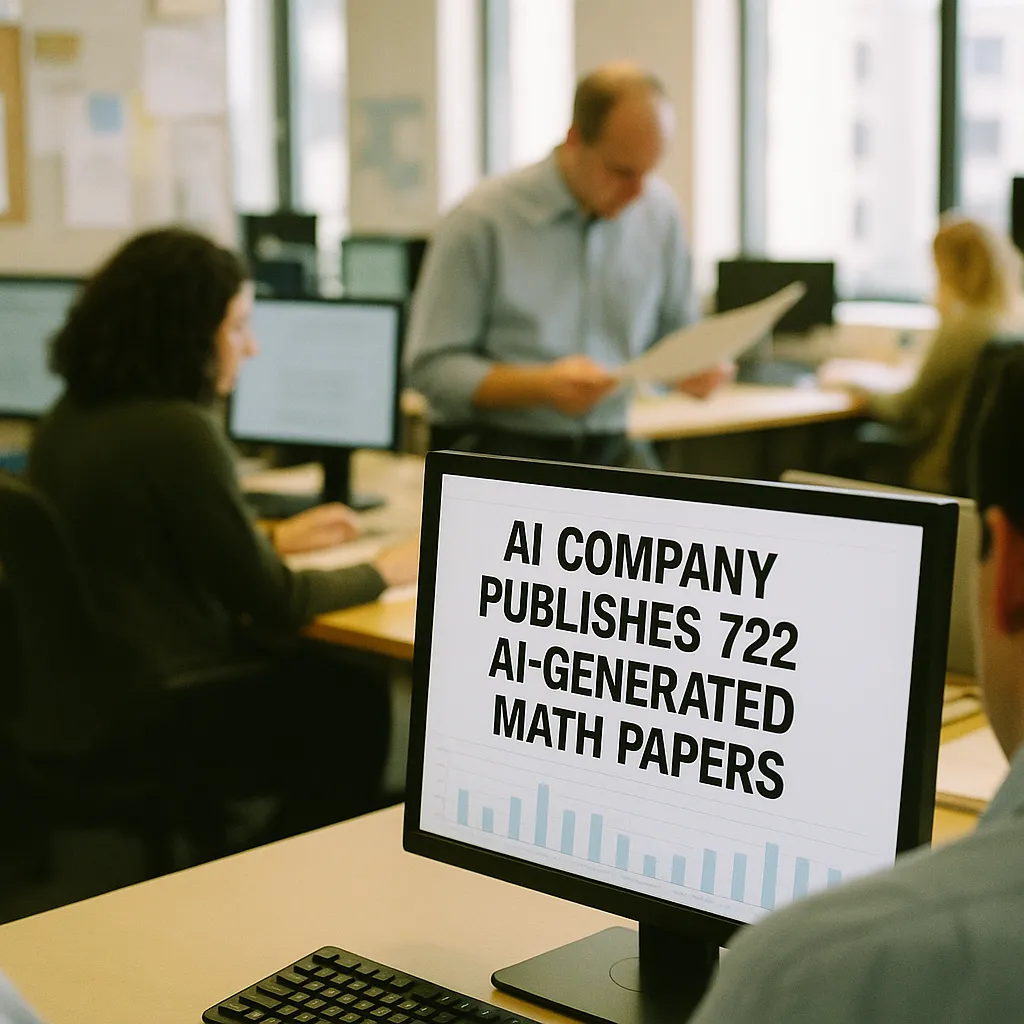
The immediate priority is independent verification of Anthropic's published methodology. Several research groups have already indicated they will replicate the approach. If it holds, expect competing AI labs — particularly OpenAI, which published [722 AI-generated](/news/openai-722-math-manuscripts-unnamed-model-2026) mathematics manuscripts on October 6 — to respond with their own frontier math results. The math race between AI labs is now in public view.
Did this help you understand AI better?
Your feedback helps us write more useful content.
Get tomorrow's AI briefing
Join readers who start their day with NexChron. Free, daily, no spam.