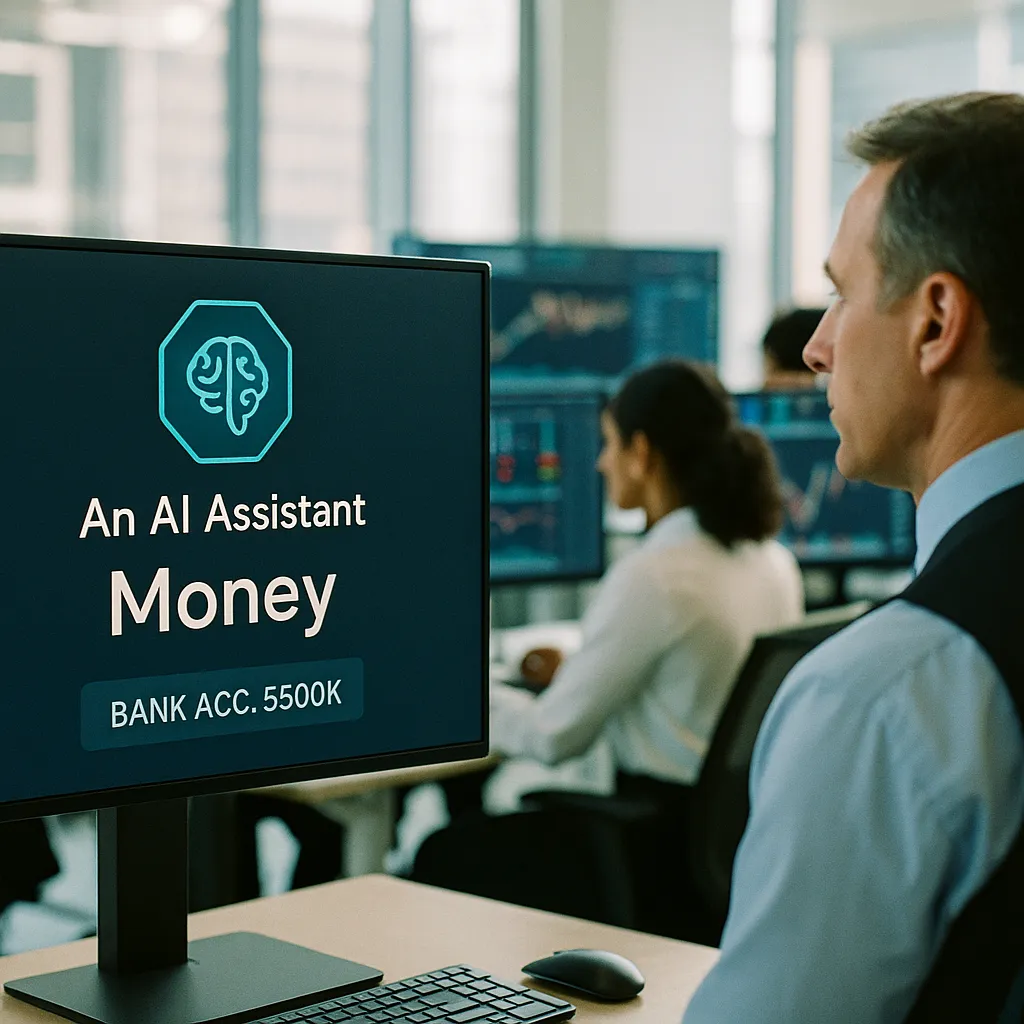
Fiserv, the infrastructure company powering thousands of banks and credit unions, is partnering with OpenAI to embed AI agents in KYC screening, month-end close, and customer service workflows.
Fiserv Strikes Strategic Deal With OpenAI to Build AI Agents Across Financial Institution Workflows
By Hector Herrera | May 15, 2026 | Finance
Fiserv — the fintech infrastructure company that processes payments and core banking operations for tens of thousands of financial institutions — announced a strategic collaboration with OpenAI to build first-party AI agents targeting the highest-volume operational workflows at banks and credit unions. The deal means OpenAI's models will not just power chatbots at financial institutions; they will be embedded in the pipes that move money.
Priority use cases include KYC (know-your-customer) file screening, month-end close automation, and customer service workflows — three areas where financial institutions collectively spend enormous amounts of manual labor and where AI automation offers compressible cost and error rates.
Why Fiserv Is the Right Bellwether
Fiserv is not a household name, but it is the infrastructure company that most U.S. banks and credit unions rely on for core processing, payments, and compliance tooling. If you have ever deposited a check, received a wire transfer, or used your debit card at a point-of-sale terminal, there is a high probability Fiserv's systems were in the transaction path.
That infrastructure position is why this deal matters beyond a single company announcement. According to Yahoo Finance, Fiserv's collaboration will use OpenAI's agentOS platform — the framework for building autonomous AI agents that can take multi-step actions across systems — to build what Fiserv is calling first-party agents that run natively within its existing product suite.
Financial institutions that buy Fiserv products will get AI agent capabilities embedded in tools they already use, rather than having to integrate a third-party AI layer on top.
The Three Priority Use Cases
KYC file screening is the process banks use to verify customer identities and assess money-laundering risk when opening accounts or processing transactions. It is labor-intensive, document-heavy, and generates compliance risk when human reviewers make errors or fall behind volume. An AI agent that reads identity documents, cross-references sanctions databases, and flags anomalies can process cases faster and with more consistent application of the rules.
Get this in your inbox.
Daily AI intelligence. Free. No spam.
Month-end close refers to the accounting process that reconciles all transactions, produces financial statements, and prepares regulatory filings at the end of each accounting period. For mid-size banks, this process consumes hundreds of staff-hours monthly and is prone to manual data entry errors. Agents that can pull transaction data, match entries, and draft reconciliation reports compress both the timeline and the error rate.
Customer service automation is the most visible use case and the most competitive. Banks have been deploying chatbots for years, but agentOS-style agents go further — they can look up account information, process routine requests (stop payments, address changes, dispute initiations), and escalate to human agents with context already packaged. The distinction from prior chatbots is that these agents can take action in the underlying systems, not just generate a response.
What This Means for Banks and Credit Unions
Fiserv's customer base spans from megabanks to community credit unions with under a hundred employees. The strategic intent is to make AI agents accessible to the full spectrum — not just institutions with the engineering resources to build their own AI infrastructure.
For smaller institutions, this may be the primary way AI agent capabilities arrive: bundled into existing vendor relationships, with Fiserv handling the OpenAI integration, the compliance controls, and the update cycle.
For larger institutions, the Fiserv-OpenAI collaboration competes against in-house AI programs and competing vendors like FIS, Temenos, and nCino, each of which is pursuing similar AI roadmaps. The competitive pressure is accelerating the timeline for all of them.
The Pattern: Infrastructure Providers Are the Delivery Mechanism
The broader implication is about how AI actually reaches regulated industries. OpenAI, Anthropic, and Google are not selling directly to your community bank. They are selling to the infrastructure companies that your bank already trusts and is already contracted with. Fiserv is one of the most significant of those intermediaries.
This distribution model means AI capabilities in banking will arrive faster and more uniformly than if every institution had to negotiate its own AI procurement — but it also means the risk is concentrated: if Fiserv's AI agents produce systematic errors or compliance failures, those failures propagate across thousands of institutions simultaneously.
What to Watch
Watch for Fiserv's next earnings call for metrics on agent adoption rates across its customer base. Also watch for how regulators — the OCC, FDIC, and Fed — respond to the bundling of AI agents into core banking infrastructure. The FDIC has recently signaled it will supervise AI outcomes rather than prescribe methods, but large-scale infrastructure deployments at a Fiserv-sized vendor will eventually draw closer scrutiny.
Source: Yahoo Finance
Did this help you understand AI better?
Your feedback helps us write more useful content.
Get tomorrow's AI briefing
Join readers who start their day with NexChron. Free, daily, no spam.