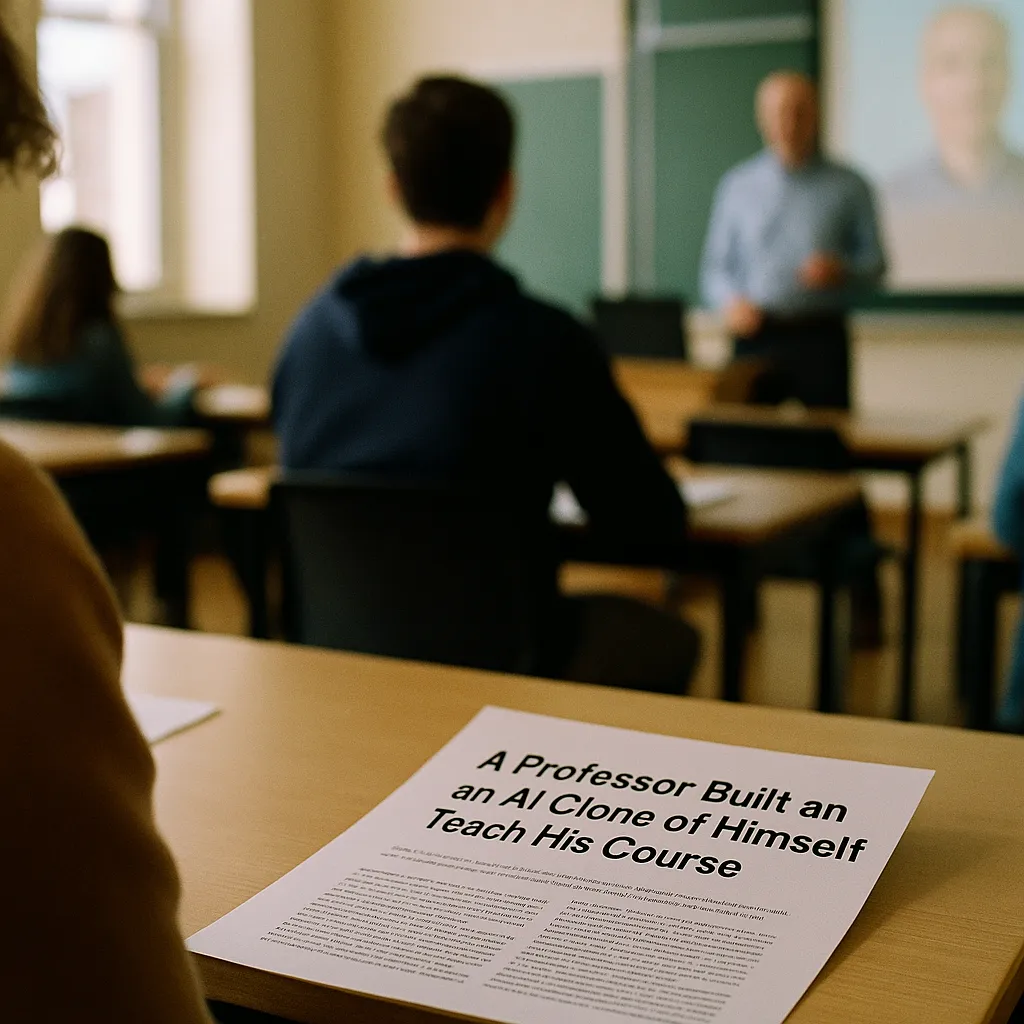
Boise State University is running a graded college course delivered entirely by an AI avatar of the human instructor — one of the first cases of full instructor replacement by AI in a degree program.
A Professor Built an AI Clone of Himself to Teach His Course. His Students Are the Experiment.
By Hector Herrera | April 24, 2026 | Education
Boise State University is running a graded college course delivered entirely by an AI-generated avatar of the human instructor — not as a demonstration, not as a hybrid experiment, but as the actual, credit-bearing course for enrolled students who need it toward their degree. U.S. News & World Report's coverage on April 23 is one of the first accounts of full instructor replacement by AI in a degree-granting program in the United States.
AI-assisted teaching tools have spread quickly across higher education since 2023 — tutoring bots, AI graders, content generators, AI writing assistants embedded in learning management systems. What's different at Boise State is the degree of substitution: the human faculty member built an avatar of themselves and delegated the actual delivery of instruction to that digital double, entirely, for the full semester.
How the Course Works
The course subject is AI applications — which is either a perfect irony or an entirely logical choice. It runs fully asynchronous: students never interact live with the human instructor. The avatar delivers course content. Students submit reflective portfolios documenting their own use of AI tools throughout the course rather than taking traditional tests or writing conventional papers.
The human professor exists. They built the avatar and designed the curriculum. But by conventional definitions, they are not teaching this course in the semester it runs.
What This Is Actually Testing
Whether you see this as pedagogical innovation or institutional overreach depends on what you believe a college course is selling.
The optimistic case: The avatar extends one instructor's reach without requiring proportional increases in their time. Students in an asynchronous format get consistent, on-demand instruction. The portfolio model may develop stronger critical thinking about AI use than a traditional exam would — asking students to document their own tool use is a more authentic assessment of AI literacy than multiple choice.
Get this in your inbox.
Daily AI intelligence. Free. No spam.
The skeptical case: Students paying tuition for an AI applications course taught by an AI are simultaneously customers of and subjects in an experiment whose educational outcomes haven't been validated at scale. The portfolio model, while thoughtful in design, has no performance baseline to measure against in this format.
The systemic concern: If one professor can serve unlimited students through an avatar, the economic pressure on institutions to reduce faculty headcount becomes acute and immediate. That's not a hypothetical — it's a straightforward cost calculation that administrators will make.
The Unresolved Questions
Who owns the professor's likeness? Most faculty employment contracts don't address AI avatar creation. A professor who builds an avatar of themselves and deploys it institutionally may have created something the university now controls — indefinitely, and potentially beyond their employment.
What does accreditation require? Regional accrediting bodies in the US require that courses be "faculty-led." Whether an AI avatar of a faculty member satisfies that definition is genuinely unresolved. No accreditor has issued formal guidance on this.
What happens when the avatar is wrong? AI systems hallucinate. In a course about AI tools, an instructor-avatar that provides incorrect information about how those tools work could cause real professional harm to students who rely on that content. The human professor's liability exposure in that scenario is unclear.
Is engagement equivalent? Research consistently shows that student-instructor relationship quality is a significant driver of retention, motivation, and learning outcomes. Whether students form a meaningful connection with an avatar — and whether that connection matters for this type of course — is an empirical question that Boise State is now in a position to answer, whether they intended to run that experiment or not.
The Ed-Tech Industry Is Watching
This course validates a product category that ed-tech companies have been quietly developing: professor-as-avatar platforms that let institutions replicate one instructor's teaching at unlimited scale without proportional cost increases. The commercial demand is real — universities face enrollment pressure, faculty costs, and scalability constraints that an avatar model could theoretically address.
Several vendors are already building in this direction. Boise State's course is generating live data on whether it works, what breaks, and how students respond. That data will be worth more to the industry than any internal pilot.
What to Watch
Whether Boise State publishes student outcome data from this course — completion rates, portfolio quality scores, student satisfaction — and how those compare to the in-person version of the same material. How the Northwest Commission on Colleges and Universities (Boise State's accreditor) responds when it reviews the course. And whether faculty unions at other institutions begin negotiating avatar-creation and deployment language into collective bargaining agreements before their administrations present it as a settled question.
Hector Herrera covers AI in education for NexChron.
Did this help you understand AI better?
Your feedback helps us write more useful content.
Get tomorrow's AI briefing
Join readers who start their day with NexChron. Free, daily, no spam.