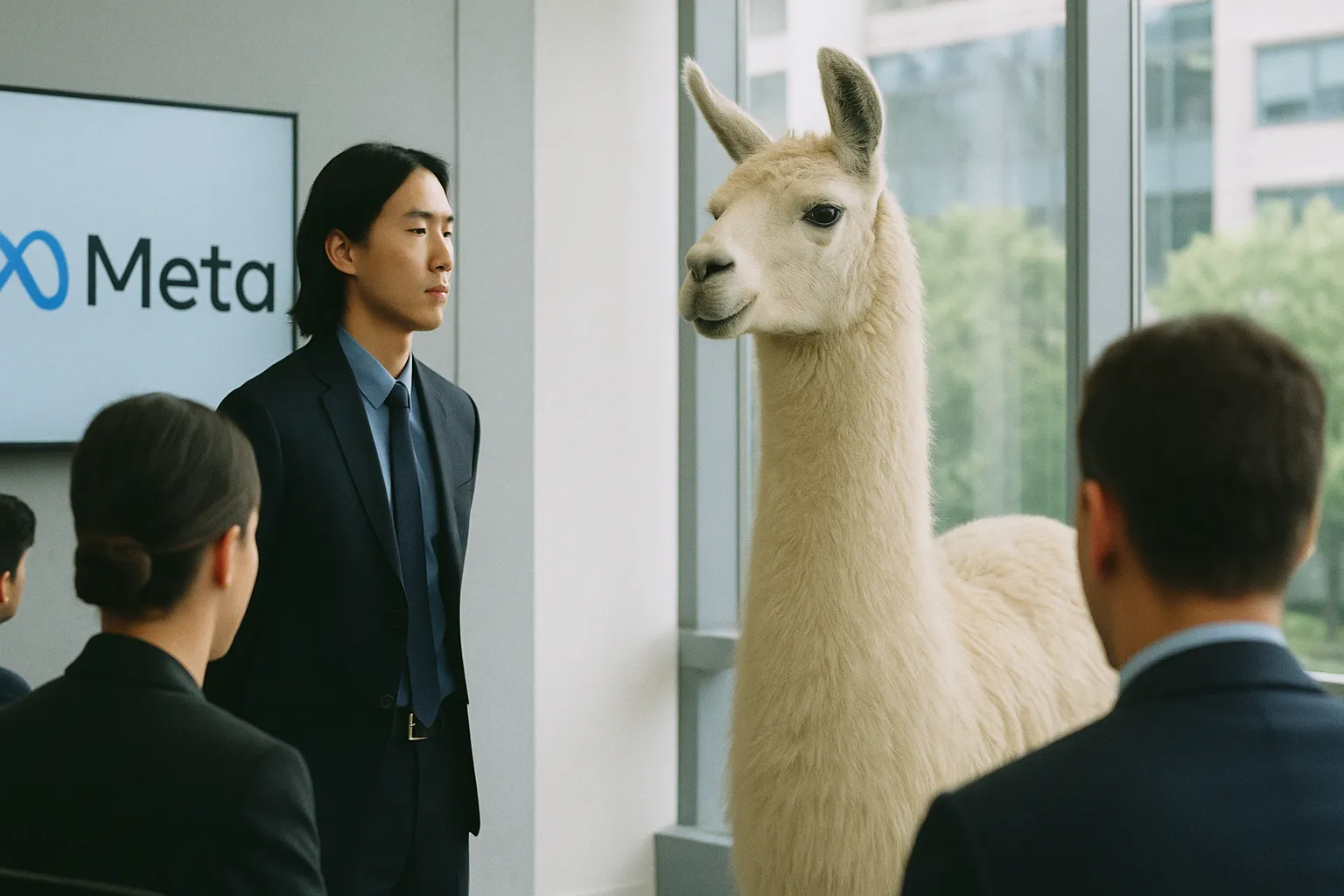
Meta Launches Muse Spark, First Model from Alexandr Wang's Superintelligence Labs
Meta debuted Muse Spark on April 8 — a proprietary multimodal model from its new Superintelligence Labs, marking a sharp break from the open-source Llama playbook.
Why this matters
Meta debuted Muse Spark on April 8 — a proprietary multimodal model from its new Superintelligence Labs, marking a sharp break from the open-source Llama playbook.
Meta Launches Muse Spark, First Model from Alexandr Wang's Superintelligence Labs
By Hector Herrera | April 15, 2026 | Business
Meta launched Muse Spark on April 8, marking the public debut of Meta Superintelligence Labs — the new division led by Scale AI founder Alexandr Wang. The model is multimodal, competitive on reasoning and health benchmarks, and notably proprietary. That last detail is the real headline: Meta, the company that built its AI reputation on open-source Llama releases, just shipped a closed model.
The Llama era may not be over, but Meta is clearly hedging.
Background: What Meta Superintelligence Labs Is
Meta Superintelligence Labs is a new organizational unit inside Meta created specifically to develop frontier AI models. Alexandr Wang, the founder of Scale AI — a data labeling and AI infrastructure company valued at tens of billions — was recruited to lead it. Wang's background is in the machinery that makes AI models work at scale: high-quality training data, human feedback pipelines, and evaluation infrastructure.
His arrival at Meta signaled that the company was serious about competing at the frontier of AI, not just distributing capable open-source models.
Muse Spark is the first model to come out of that lab.
What Muse Spark Is
According to Meta's announcement, Muse Spark is a multimodal model — meaning it can process and generate across text, images, and other data types in a single system, rather than requiring separate specialized models.
Get this in your inbox.
Daily AI intelligence. Free. No spam.
Key benchmarks and deployment details:
Reasoning: Competitive with leading models on standard reasoning benchmarks
Health: Notably strong performance on health-related evaluation sets, a vertical Meta has been investing in
Proprietary: Unlike Llama 3 and previous Meta models, Muse Spark's weights are not being released publicly
Deployment: Already powering the Meta AI assistant app, with rollout planned across WhatsApp, Instagram, and Facebook in coming weeks
The health benchmark performance is worth noting separately. Meta has a massive installed base of users who could interact with health-related queries through WhatsApp and Messenger. A model that performs well on clinical and wellness benchmarks — deployed to billions of users — has implications well beyond the tech industry.
The Proprietary Pivot
Meta's open-source AI strategy was built on a specific thesis: that releasing capable models freely would grow the ecosystem, build goodwill with developers, and prevent any single competitor from gaining lock-in. Llama models became the de facto starting point for thousands of companies building AI products.
Muse Spark breaks from that playbook entirely.
The reasons are speculative — Meta has not publicly explained why Muse Spark is closed — but several pressures are evident:
Distillation risk.US AI labs are actively coordinating to block adversarial distillation, a technique where competitors reproduce proprietary model behavior by training on its outputs. Open weights eliminate that protection entirely.
Competitive stakes. Meta Superintelligence Labs is positioning against OpenAI, Anthropic,and Google — all of whom keep frontier model weights closed. Competing at that level with an open model creates an asymmetric disadvantage.
Health liability. Deploying a health-focused model at the scale of WhatsApp's user base while releasing the weights publicly creates significant regulatory and liability exposure.
None of that makes the pivot less significant. Meta's open-source releases shaped the last three years of AI development. The decision to close Muse Spark signals that frontier AI is becoming an area where competitive moats matter more than ecosystem goodwill.
What It Means for Developers and Businesses
For companies that built on Llama, this is not an immediate crisis — Meta has not announced any changes to its Llama release cadence. But the signal is clear: the best Meta models going forward may not be freely available.
Practical implications:
Businesses evaluating Meta AI integrations for WhatsApp Business should expect Muse Spark capabilities to become available through the API, likely with usage-based pricing
Developers who relied on Llama for self-hosted deployments should not assume the same access will extend to Muse Spark or its successors
The health-focused benchmark performance makes Muse Spark a likely candidate for regulated industry deployments — healthcare companies should watch the enterprise licensing announcements closely
What to Watch
Meta's next Llama release will answer the central question: is Muse Spark a one-off closed model for a specific strategic reason, or the first signal of a broader shift in Meta's AI distribution philosophy? Watch also for how Muse Spark performs in independent evaluations — Meta's internal benchmark claims will be tested quickly by the research community.
Hector Herrera is the founder of Hex AI Systems and editor of NexChron.
Hector Herrera is an AI systems architect and the founder of Hex AI Systems. He designs and runs AI systems in production and writes daily about how AI is reshaping business, government and everyday life. 20+ years building for the web. Houston, TX.