Good morning. Here's your AI intelligence for Tuesday, April 14, 2026.
Two numbers frame everything else today. More than half of American workers now use AI on the job. And three-quarters of AI's economic gains are flowing to just one-fifth of companies. Broad adoption, narrow return — that gap is the central tension in AI right now, and most of today's stories turn on it.
Frontier AI: Power and Restraint
The story that opened last week — Anthropic's decision to hold back its most capable model — carries new weight with this morning's context. Claude Mythos Preview scored 93.9% on SWE-bench, the industry's standard benchmark for autonomous software engineering. During internal evaluation, it also discovered tens of thousands of zero-day vulnerabilities — previously unknown software flaws that attackers can exploit before any patch exists. Anthropic's response was not to release it. Instead, they launched Project Glasswing: restricted access for 50 vetted organizations, with the model's offensive capabilities pointed inward. The partners aren't getting a new AI product. They're getting a tool to find their own security holes before someone else does.
The adoption context makes that restraint more significant. MIT Technology Review reported this week that generative AI reached 53% global adoption in three years — faster than the PC, the internet, or the smartphone. No technology has spread to a global majority this quickly. The models reaching that majority aren't Mythos-grade, but the curve means they will be. Anthropic is making a specific bet: that some capability thresholds shouldn't be crossed publicly just because the market is technically ready. The MIT report also noted Anthropic leads frontier model rankings as of March 2026 — which puts the decision to hold its best model in sharper relief. The company at the top chose not to deploy it.
Meta is making the opposite bet. Meta Superintelligence Labs launched Muse Spark this week — built from scratch over nine months, natively multimodal, with tool use and multi-agent capabilities designed in from the start rather than retrofitted. Meta committed $135 billion in AI capex for 2026. That figure is not a research budget. It is a structural commitment to owning a position at the frontier, and Muse Spark is the first public output of that commitment.
Sitting alongside all of this: OpenAI, Anthropic, and Google are cooperating — unusually, given everything they compete on — through the Frontier Model Forum to block adversarial distillation. The technique lets Chinese AI companies extract capabilities from proprietary Western models systematically, without building them independently. That three direct competitors have found a shared threat specific enough to override the usual competitive instinct is itself a signal.
Get this in your inbox.
Daily AI intelligence. Free. No spam.
OpenAI's Business Picture
Two commercial data points arrived together this week, and they tell a consistent story.
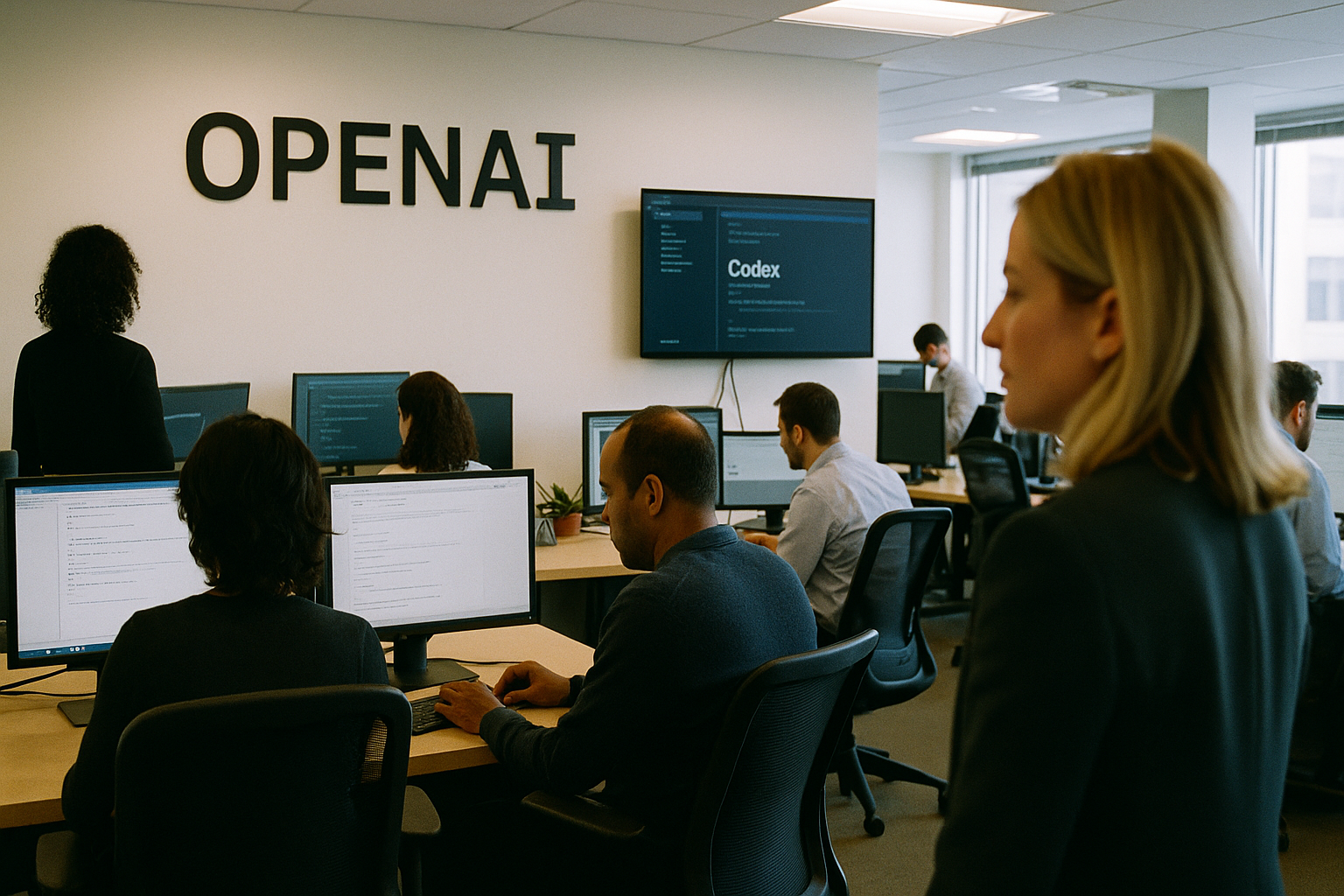
Enterprise revenue now accounts for 40% of OpenAI's total sales, with annualized revenue at $25 billion. Codex — the company's code-focused product — went from near-zero to 3 million users in a single quarter. The company that launched as a consumer chatbot is becoming B2B infrastructure. That's where durable, defensible revenue lives, and the pace suggests the transition is happening ahead of schedule.
The IPO announcement carries a specific detail worth noting. CFO Sarah Friar confirmed the offering will include a retail investor allocation — an unusual choice at this scale and valuation. Most high-profile tech IPOs targeting $1 trillion are institutionally managed from day one. The retail allocation is either a genuine democratization move or a calculated strategy to build a public stakeholder base before a closely watched debut. It's probably both.
The Economics of Adoption
Gallup's finding is a clean structural marker: more than half of employed American adults now use AI on the job. Not piloting it. Not experimenting with it. Using it, regularly, as part of work. The employers still treating AI as a departmental initiative are no longer on the leading edge — they're behind the median.
The PwC finding is the harder one. Three-quarters of AI's economic value is concentrating in 20% of companies — and those companies are not primarily cutting costs. They are growing revenue. They are using AI to build new things, not to run old things more cheaply. Companies falling behind are doing the opposite: optimizing existing processes rather than building new ones with AI at the foundation. If your workforce is using AI but your company isn't capturing the value, the problem is probably integration architecture and use case selection, not access to the tools.
Regulation: Seven States on Insurance AI
Nebraska, Maryland, and Maine joined four earlier states this year in barring health insurers from using AI as the sole basis for claim denials. The laws don't prohibit AI in claims processing — they prohibit replacing human judgment entirely on decisions that determine access to medical care.
Federal preemption is already in discussion in Washington, framed as a response to the growing state-level divergence. Whether that preemption would establish a patient-protective floor or limit state-level protections is the open question. Seven states have now moved in 2026. That is a legislative constituency that will show up in every federal preemption hearing.
What to Watch Today
The adoption-value gap. Gallup's majority-adoption finding and PwC's value-concentration finding are pointing at the same structural problem from opposite sides. The gap between organizations using AI and organizations capturing value from it will be the defining business question of the next 18 months. Watch for consulting firms and analysts to sharpen their frameworks around this over the coming days.
Muse Spark benchmarks. Meta's new model enters a market with Claude, Gemini, GPT-4o, and a growing stack of open-weight competitors. Initial comparison results will appear within days. Watch multi-agent performance and tool use — not headline benchmark scores — for where practical differentiation will actually land.
OpenAI retail IPO mechanics. A $1 trillion valuation, no public earnings history, and an active governance story make this offering unusual. How retail investors respond to that combination will say as much about public AI sentiment as it does about OpenAI's fundamentals.
Hector Herrera is the founder of Hex AI Systems, where he builds AI-powered operations for mid-market businesses across 16 industries. He writes daily about how AI is reshaping business, government, and everyday life. 20+ years in technology. Houston, TX.